There may be no more photographed beer spot in Europe than the terrace of Brouwerij 't IJ, sitting in the shadow of a towering wooden windmill in eastern Amsterdam. But this is far more than a pretty picture: it is a founding brewery of the Dutch craft revival, pouring excellent Belgian-style beer on the very spot where it is made.
Why Brouwerij 't IJ is our No. 10
Brouwerij 't IJ earns its place on our world craft beer ranking through a rare combination of heritage, quality and sheer sense of place. It is one of the breweries that kicked off the modern Dutch craft movement back in the 1980s, its classic beers still hold up beautifully, and its tap room at the foot of the De Gooyer windmill is one of the genuine landmarks of European beer. Few places offer all three at once.
It ranks tenth because that iconic setting comes with real substance behind it. This is not a novelty photo stop; it is a working brewery with decades of history and a range of well-made, largely organic beers that reward serious attention. To drink a fresh Zatte on the terrace as the windmill turns overhead is one of the quintessential beer experiences of the continent, and a fitting way to round out the top ten.
A brewery born in a bathhouse
Brouwerij 't IJ opened in October 1985, founded by Kaspar Peterson, a former musician who had fallen in love with Belgian ales while touring and wanted an outlet for his own home-brewing. He set up the brewery in a former municipal bathhouse in Amsterdam-Oost, a practical choice, since the building already had the water supply, drainage and steam capacity a brewery needs, and, crucially, right next to the De Gooyer windmill. It was one of the pioneering microbreweries of the post-war Dutch beer revival, arriving at a time when the country's beer landscape was almost entirely industrial pilsner.
That founding-era pedigree matters. When Peterson started brewing Belgian-inspired ales in Amsterdam in 1985, he was decades ahead of the craft wave that would eventually sweep the Netherlands, and 't IJ became one of the reference points that a later generation of Dutch brewers looked back to. The brewery's playful identity, its logo is an ostrich with an egg, a pun on the Dutch word for ostrich and the beer Struis, captures the slightly irreverent, pioneering spirit that has always run through it.
Beer under the windmill
The setting is genuinely special. The De Gooyer windmill, beside which the brewery and tap room sit, is the tallest wooden windmill in the Netherlands, and the sight of drinkers gathered at the foot of it with glasses in hand is one of the most recognisable images in European beer. On a sunny day the terrace fills, the mill turns overhead, and the whole scene feels like a distillation of everything charming about Amsterdam.
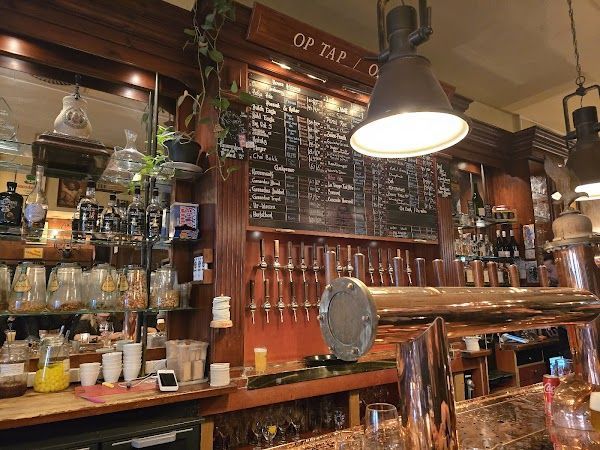
It would be easy for a place with a view like this to coast, but 't IJ does not. The setting draws you in, and the beer keeps you there. That balance, a genuine landmark that also happens to make excellent beer, is exactly what lifts it onto a world list, rather than merely a list of pretty places to take a photograph. The room and terrace are compact and characterful, and the sense of drinking at the source, a few metres from the brewing kit, adds to the pleasure.
Zatte, Struis and the organic range
The beer to order is Zatte, the brewery's 8% Belgian-style tripel and one of its original 1985 recipes, unfiltered, characterful and still the flagship after four decades. From there the range runs through classic Belgian-inspired styles: Natte, a dubbel; Struis, a 9% dark strong ale that shares its name with the ostrich on the logo; and the strong, hoppy Columbus. Several of the core beers, Natte, Zatte, Columbus and Struis among them, are certified organic, a reflection of the brewery's values as much as its palate.
These are beers built on Belgian tradition rather than chasing the latest trend, and they have aged well precisely because they were never fashionable in the first place. Drinking them fresh, on site, is the ideal way to experience them: a tripel like Zatte is at its expressive best young and unfiltered, and there is nowhere fresher than the tap room a few steps from the tanks. For anyone who loves the classic strong ales of the Low Countries, this is essential drinking.
An honest note on ownership
In the interest of accuracy, one point worth making plainly: since 2015, Brouwerij 't IJ has operated in partnership with the Belgian brewer Duvel Moortgat. It began life as a scrappy independent microbrewery, and that pioneering history is real, but for the last decade it has been Duvel Moortgat-backed rather than fully independent. We flag this because ownership matters to some drinkers, and because honesty about it is part of our job.
In practice, the brewery and its windmill tap room continue to operate under their own identity, with the same beers and the same setting that made them famous. The partnership has not turned 't IJ into something it is not; the Zatte still tastes like Zatte, and the terrace still sits under the mill. But you should know the full picture, and now you do.
Amsterdam-Oost and getting there
Brouwerij 't IJ sits at Funenkade 7 in Amsterdam-Oost, a little east of the city centre and an easy tram or bicycle ride from the middle of town, the very Amsterdam way to arrive. The neighbourhood around it is pleasant and residential, and the brewery makes a natural anchor for an afternoon exploring the east of the city. Because of its residents, the tap room has historically kept relatively early hours, closing in the evening rather than running late, so it is best planned as a daytime or early-evening visit rather than a nightcap.
For beer travellers, 't IJ pairs beautifully with a stop at the all-Dutch Arendsnest on the canals: between them they capture both the pioneering, brewery-led side of Dutch beer and the curated, showcase side, old and new. A second 't IJ bar has also opened in the Blauwe Theehuis in Vondelpark, giving visitors on the other side of town a taste of the brewery without the trip east.
Its place in Dutch beer history
It is easy, standing on the sunlit terrace, to forget how radical Brouwerij 't IJ once was. In 1985 the Netherlands was not a country anyone associated with adventurous beer; the market was dominated by a few giant pilsner brands, and a small brewery making unfiltered Belgian-style tripels in a converted bathhouse was a genuine outlier. Peterson was brewing against the grain, for a taste the market had not yet developed, and it took real conviction to keep at it.
That early, stubborn work is why 't IJ is remembered as a pioneer rather than merely an old brewery. The Dutch craft scene that blossomed in the following decades, the same scene celebrated a few kilometres away at Arendsnest, grew in part from the ground that breweries like this one broke first. When we place 't IJ in the top ten, we are honouring not only what it pours today but the role it played in making Dutch beer worth talking about at all.
More than a photograph
A setting this striking carries a risk: that a place becomes famous for its looks and forgets to be good. Plenty of scenic bars around the world coast on their views. What makes 't IJ special is that it never has. The beer is the equal of the setting, well-made, distinctive, largely organic, rooted in Belgian tradition rather than chasing novelty, and the brewery has kept its standards through four decades and a change of backing.
That is the real reason it belongs on a world list rather than a list of pretty terraces. The windmill gets you in the door; the Zatte is why you order a second. When both the view and the glass are this good, and the history behind them this deep, you have something that very few bars anywhere can match, a landmark that is also, quietly, a serious brewery.
It is also, for all its fame, an unpretentious place. There is no velvet-rope exclusivity here, no sense of a brand trading on its image, just benches, glasses, the smell of the brewery and the slow turn of the sails. That easy, democratic charm is part of why locals still treat it as their own even as the tour groups arrive, and why a first-time visitor and a lifelong regular can share the same bench happily.
Who it is for
Brouwerij 't IJ is for just about everyone, which is part of its magic. The dedicated beer lover comes for a founding brewery of the Dutch revival and a fresh, unfiltered Zatte at the source; the casual visitor comes for one of the most beautiful beer terraces in Europe and stays for a genuinely good drink. It suits couples, groups, solo travellers and sightseers equally, and its daytime hours make it a natural fixture of an Amsterdam afternoon. About the only person who might be caught out is the night owl expecting a late session, this is a place for daylight and early evening, under the turning sails of the mill.
The verdict
We rank Brouwerij 't IJ tenth in the world because it delivers something very few beer bars can: real brewing heritage, genuinely good beer, and a setting so iconic it has become a symbol of Amsterdam itself. It helped start the Dutch craft revival, it still makes excellent, largely organic Belgian-style ales, and it pours them at the foot of a windmill. Duvel Moortgat-backed but unchanged in spirit, it is both a landmark and a proper brewery, and a perfect close to the top ten. Beautiful and serious in equal measure, and unmistakably of its city, it is a fitting way to close out the very top of the ranking. Explore more with our Amsterdam craft beer guide and Amsterdam bar guide.
What to order
- 01
Zatte
The 8% tripel and flagship, one of the original 1985 recipes.
$$ - 02
Struis
A 9% dark strong ale; shares its name with the ostrich logo.
$$ - 03
Natte
The organic dubbel, classic Belgian-style depth.
$$ - 04
Columbus
Strong and hoppy; another of the organic core beers.
$$
Brouwerij 't IJ FAQ
What is Brouwerij 't IJ known for?
A pioneering Amsterdam microbrewery opened in 1985 in a former bathhouse in Amsterdam-Oost, beside the De Gooyer windmill, the tallest wooden windmill in the Netherlands. It is known for its organic, Belgian-inspired beers, especially the 8% Zatte tripel, and for one of Europe's most iconic tap-room settings.
What should I order?
Order the Zatte, the 8% Belgian-style tripel and one of the original 1985 recipes. Other classics include the 9% Struis, the Natte dubbel and the Columbus, several core beers, including Natte, Zatte, Columbus and Struis, are certified organic.
Is it independent?
It began as an independent microbrewery in 1985 and has operated in partnership with Belgium's Duvel Moortgat since 2015. The brewery and windmill tap room keep their own identity, so it is best described as Duvel Moortgat-backed rather than a lone independent.
Why is it ranked among the world's best?
It is a founding brewery of the Dutch craft revival, its classic Belgian-style beers are excellent, and its tap room at the foot of the De Gooyer windmill is one of the most iconic beer settings in Europe, heritage, quality and sense of place together.
Sources & further reading
Editorial research drew on the Wikipedia entry for Brouwerij 't IJ, the brewery's own site (including its statement on the Duvel Moortgat partnership) and I Amsterdam. The 1985 opening by Kaspar Peterson, the bathhouse and windmill setting, the Zatte and organic beers, and the 2015 Duvel Moortgat partnership are drawn from these sources; the ranking and opinions are the barsforKings editorial team's own. Spot an error? Tell us via corrections.