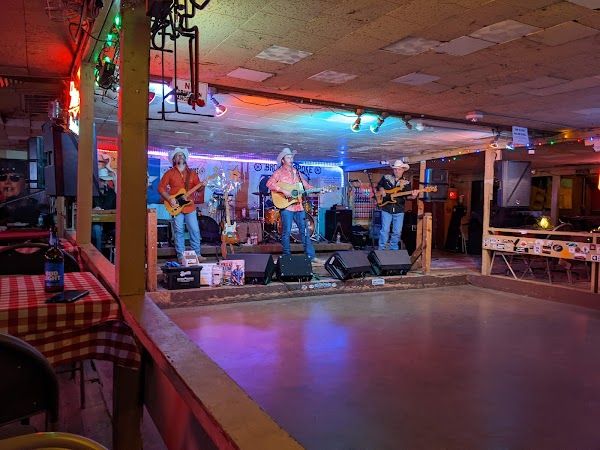
If Austin is the Live Music Capital of the World, Antone's is a large part of the reason why. Since 1975 it has been the city's "Home of the Blues", the room where touring legends played, where a generation of Texas guitar players learned their trade, and where the blues has been kept alive night after night for half a century. Unlike the pure listening rooms above it on our list, this is a proper nightclub: a stage, a dance floor, a full bar and a kitchen that does a mean po'boy.
Antone's has moved around Austin many times over fifty years, but its identity has never wavered. Today it sits at 305 East 5th Street downtown, a mid-size club with a stage and dance floor below and a large event space upstairs. Walk in on the right night and you'll find exactly what Clifford Antone wanted when he opened the doors in 1975: real blues, played loud, for people who came to hear it. That combination of history, influence and genuine bar-and-club energy is why we rank it third among the best live music bars in the world.
"We wanted to hear blues before these musicians died"
Clifford Antone was 25 years old and a Port Arthur native when he opened the first Antone's in 1975, in a converted furniture store on 6th Street. His motive was as simple as it was urgent. "Me and my friends wanted to hear blues before these [musicians] died," he later said, and so he began booking the touring giants of the genre into his club. The opening weekend featured the zydeco king Clifton Chenier and His Red Hot Louisiana Band. In the years that followed, the stage carried Muddy Waters, B.B. King, John Lee Hooker, Jimmy Reed, Otis Rush, Albert King, Albert Collins, Clarence "Gatemouth" Brown, Pinetop Perkins and Fats Domino, among many others.
What made Antone's more than a stop on the touring circuit, though, was what happened between the visits. Clifford Antone became a mentor to a young Austin scene, and the club functioned as a kind of blues conservatory. Stevie Ray Vaughan, his brother Jimmie Vaughan, Kim Wilson and the Fabulous Thunderbirds, Lou Ann Barton and Angela Strehli all came up around Antone's, and later so did Gary Clark Jr. The club spun off Antone's Records in 1987 and a beloved record shop, extending its role from venue to institution. When Clifford died in 2006, Austin's then-mayor Will Wynn put it plainly: "One of the primary reasons Austin is known as the Live Music Capital of the World is because of Clifford Antone."
The rooms Antone's has lived in
It is worth being accurate about the club's geography, because the "since 1975" on the sign refers to the institution, not the address. The original 1975 club stood on 6th Street. In 1982 it moved to a former pizza parlour on Guadalupe near the University of Texas, the room where Stevie Ray Vaughan and the Fabulous Thunderbirds broke nationally, and where, legend has it, U2 once dropped in to soak up the sound. Further moves followed to 5th and Lavaca, then Riverside, before a brief hibernation after Clifford's death. A new team restored and reopened the club at its current 305 East 5th Street home on New Year's Eve 2015, with C.J. Chenier, son of that first opening-night bandleader, on stage. In 2025 the club marked its 50th anniversary.
What the room is like
The current Antone's is a genuine club, not a shrine behind glass. There's a stage, a dance floor and a full bar downstairs, with a roughly 5,800-square-foot event space of around 250 capacity upstairs; the downstairs room holds a few hundred standing. It is warm, loud and social in the way a blues club should be, a place to drink, dance and shout for another song rather than sit reverently in the dark. That is a deliberate and important difference from the Village Vanguard or Preservation Hall: here, the audience is part of the show.
The food: Cliffy Dogs and famous po'boys
Antone's is one of the few venues near the top of our list where you can, and should, eat. During showtimes the club serves beer-steamed "Cliffy Dog" hot dogs, and the adjoining Big Henry's, which doubles as a record shop and box office, turns out "Antone's Famous Po' Boys" in variations including the Original, Turkey and Swiss, a premium roast beef, tuna, and one cheerfully named "The Piggy." The po'boy recipe reportedly traces back to Clifford's uncle Jalal Antone in 1962, a nice thread of family history running through the whole operation. It all reinforces the point: this is a full night out, music, drinks and food under one roof, rather than a ticketed concert you file into and out of.
Why we rank it No. 3
Antone's earns its place for the rare way its influence runs in two directions at once. It honoured the touring blues elders when few American clubs were bothering to, and it simultaneously built the next generation of players who would carry the music forward. Very few venues can claim to have both hosted Muddy Waters and launched Stevie Ray Vaughan. Add the record label, the record shop and fifty years of continuous operation, and you have not just a great club but a cultural engine that helped define an entire city's identity.
It sits at three, just below Preservation Hall, because its focus is a touch broader, a working nightclub with a modern, somewhat more varied booking policy rather than a single-minded temple to one tradition. But as a living, drinking, dancing blues institution, nothing in America is quite its equal, and on the right night it is the most fun you can have on this entire list.
Getting in: what to expect
Antone's runs on a show-by-show calendar rather than a fixed nightly residency, so the first step is always to check what's on. Tickets are sold in advance through the club's website and the usual ticketing partners, and group sales are handled through the box office. Most shows are 21-and-over unless otherwise noted, so bring ID. Big Henry's, next door, functions as the on-site box office and a place to hang, buy vinyl and eat before the music starts.
Because the bill varies so much, from local blues nights to national touring acts, it pays to look at who's playing before you plan your evening. On a marquee night, arrive early for a good spot near the stage; on a local blues night, roll in later and settle in at the bar. Either way, this is a room designed to be lingered in.
Drinks, food and money
This is a full-service bar, which is a relief after the abstemious rooms higher on our list. Order a cold Texas beer, a whiskey or a simple mixed drink, grab a Cliffy Dog or a po'boy, and settle in. Our $$ rating reflects a moderate cover charge that varies by act plus normal bar and food prices, a genuinely accessible night out for the calibre of music. There's no pretension here and no minimum-spend gymnastics; you pay to get in and then you drink and eat as you please.
Who it's for
Antone's is for blues lovers, obviously, but also for anyone who wants a real Austin night out with live music at its centre, couples, groups of friends, music tourists making the pilgrimage, and locals who treat it as a second living room. It's more forgiving of a lively group than the listening rooms above it, and the food and full bar make it easy to build a whole evening around. If you want to understand why Austin sounds the way it does, this is where you start.
Build out your trip with our Live Music Bars in Austin guide, the Broken Spoke honky-tonk (No. 8 on our list) makes a perfect contrast, and see where Antone's lands among the world's best on our full 25 best live music bars ranking. The Austin Bar Guide has the rest.
The Antone's family tree
To understand Antone's is to trace the players who passed through it. The club's house scene in the late 1970s and early 1980s became a finishing school for a generation of Texas blues musicians. A teenage Stevie Ray Vaughan cut his teeth here before becoming one of the most influential guitarists of his era; his brother Jimmie Vaughan and the Fabulous Thunderbirds, with harmonica player Kim Wilson, built their sound in the same rooms. Vocalists Lou Ann Barton and Angela Strehli were central to the scene, and years later a young Gary Clark Jr. would come up through the same club. That lineage, nurtured directly by Clifford Antone, who treated the club as a school as much as a business, is a large part of why Antone's matters far beyond Austin.
The influence flowed outward through Antone's Records, founded in 1987 to document the artists Clifford loved, and the associated record shop, which became a hub for blues obsessives. Few clubs have produced a comparable body of recorded work or launched so many careers from a single stage.
Clifford Antone's legacy
Clifford Antone died in 2006 at the age of 56, and the outpouring that followed made clear how singular his role had been. The city he helped define mourned him as a civic figure, not merely a club owner; Mayor Will Wynn credited him directly for Austin's identity as the Live Music Capital of the World. A 2006 documentary, Antone's: Home of the Blues, chronicled the club's story and its founder's devotion to the music, and was recognised by the Blues Foundation with a Keeping the Blues Alive Award in 2007. When a new team restored and reopened the club in 2015, it did so consciously as an act of stewardship, reviving not just a venue but a mission.
Frequently asked
Is Antone's still at its original location? No, the institution dates to 1975, but it has occupied several homes and has been at 305 East 5th Street since New Year's Eve 2015. Do I need tickets? Yes for most shows, bought in advance; the calendar is show-by-show rather than a fixed nightly residency. Is there an age limit? Most shows are 21-and-over, so bring ID and check the listing. Can I eat there? Yes, "Cliffy Dog" hot dogs during shows and po'boys at the adjoining Big Henry's, which also serves as the box office and record shop. What kind of music will I hear? Primarily blues, with zydeco, R&B, soul and roots in the mix.
The verdict
Antone's is proof that a great music venue can also be a great bar, that reverence and a good time are not mutually exclusive. Fifty years on, through half a dozen addresses and the loss of its founder, it still books the blues, still pours the beer, still fries the po'boys, and still matters to Austin more than almost any other room in town. That is a rare and hard-won kind of greatness, and it earns Antone's its place near the very top.
What to order
- 01
A cold Texas beer
The right drink for a blues night, simple, cold and bottomless.
- 02
An Antone's Famous Po' Boy
From Big Henry's next door; the recipe dates back to the family in 1962.
- 03
A beer-steamed "Cliffy Dog"
The house hot dog, served during showtimes.
Sources
Antone's Nightclub official site (antonesnightclub.com); Texas State Historical Association, Handbook of Texas; contemporary Austin press coverage of the club's history and 2015 reopening; the documentary Antone's: Home of the Blues (2006). Capacity figures are approximate and drawn from event listings; the club's calendar and age policies change by show, confirm before visiting.