The best rooftop in Madrid is not on a hotel. It crowns the Circulo de Bellas Artes, a century-old arts centre on Calle de Alcala, about 56 metres above the street, and you reach it by a dedicated glass lift and, charmingly, a small entry fee of a few euro. What you buy is one of the great central-Madrid panoramas: Gran Via and the winged dome of the Metropolis building below, the tiled rooftops of the old centre spreading in every direction, and a sky that turns molten at sunset. It is democratic, cultured and quietly grand, and it earns eighth place on our list of the world's best rooftop bars.
The building: an arts centre with a view on top
To understand the Azotea you have to understand what is beneath it. The Circulo de Bellas Artes is a private, non-profit cultural institution founded in 1880 by a group of artists, and for well over a century it has been one of Europe's most important arts centres, programming exhibitions, film, literature, philosophy and performance under one roof. Its home is a landmark in its own right: a monumental building designed by the architect Antonio Palacios and inaugurated in 1926, declared a protected national monument in 1981, and now standing within the "Paisaje de la Luz," the Madrid cultural landscape inscribed as a UNESCO World Heritage site in 2021. The terrace at the very top is crowned by a statue of Minerva, the Roman goddess of wisdom and the arts, a longstanding symbol of the Circulo. All of that history sits under your feet when you order a drink.
Getting up: a lift, a ticket and the Minerva
Access is part of the charm and part of what sets the Azotea apart from a hotel sky-bar. You buy a ticket at the building's reception, ride a glass-doored lift straight to the roof, and step out onto the terrace beneath the Minerva statue. The admission is a token amount, currently around five euro, and it doubles as access to the building's cultural spaces; it does not, however, guarantee a table in the bar-cafe area, so at busy times the roof can feel like the civic viewpoint it fundamentally is rather than an exclusive lounge. That small cover charge is precisely what keeps the place feeling open to the whole city rather than roped off, and it is a large part of why locals still treat it as their own.
The view: 360 degrees of central Madrid
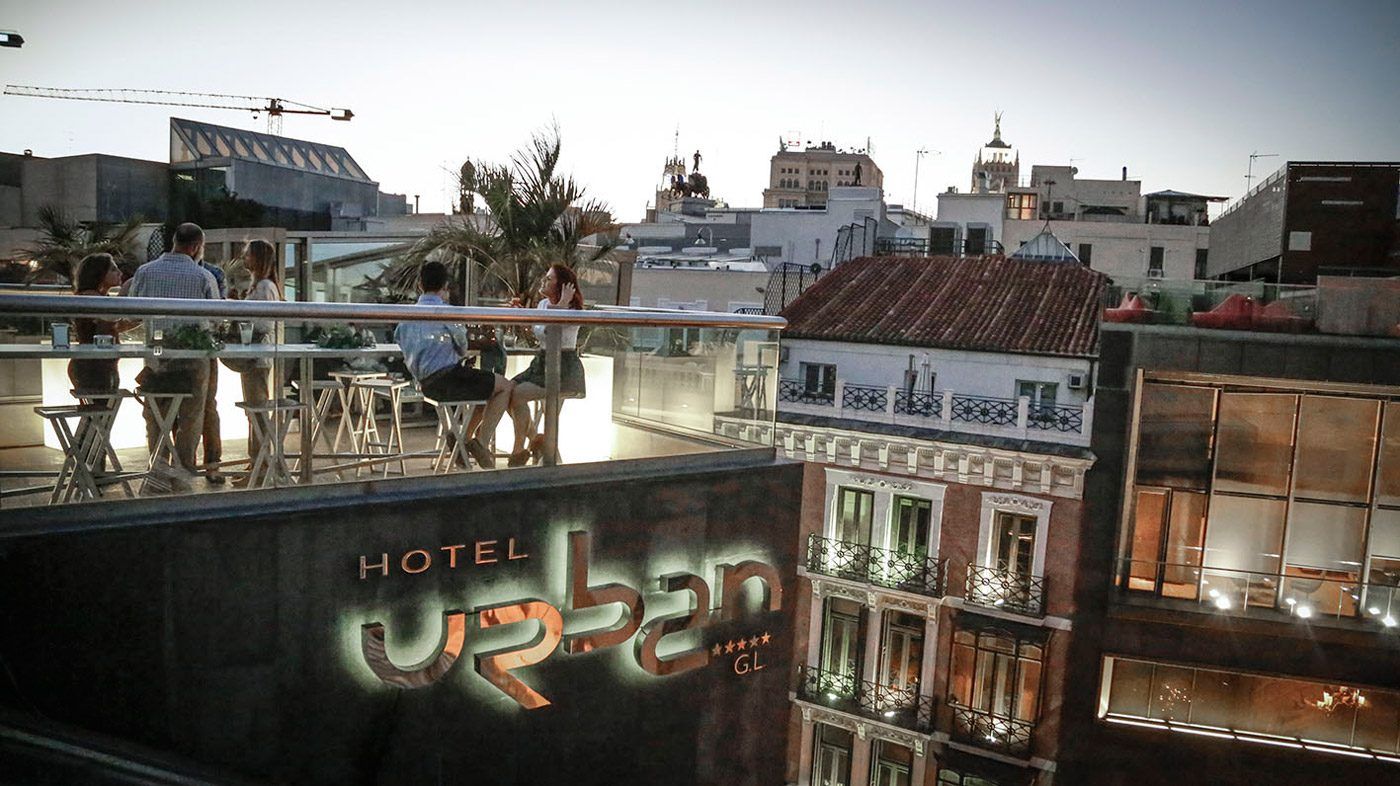
From 56 metres up the terrace offers a full 360-degree panorama of the heart of Madrid. The headline sightlines take in Calle de Alcala and Gran Via, with the domed, sculpture-topped Metropolis building prominent in the near view and the Telefonica tower rising along Gran Via beyond; turn around and the tiled rooftops of the centro roll toward the horizon. It is repeatedly named among the best viewpoints in the city, and it is famous above all for its sunsets, when the low light gilds the rooftops and the sky behind the Guadarrama horizon colours. Come in the hour before dark and you get the city at its most photogenic, then the slow switch to a carpet of lights.
Tartan Roof and Tartan Lodge: the operator
The food-and-drink concept on the roof is Tartan Roof, created by the chef Javier Munoz-Calero and launched in 2013 as a gastro-cultural project sitting on top of the arts centre. It is a genuinely seasonal operation, and the name changes with the weather: in the warm months it runs as Tartan Roof, with an easy, terrace-bar feel, and in the colder months it transforms into Tartan Lodge, a snugger, alpine-refuge concept, so the rooftop reinvents itself twice a year. The food is an urban, travelled menu with strong Asian and South American influences alongside Mediterranean dishes, pitched for grazing rather than formal dining, and the drinks run to cocktails and a well-regarded selection of gins for the gin-tonic that Madrid loves. Live music is part of the offer too, with the Circulo running a jazz programme on the terrace. (You may see specific "signature" cocktails attributed to the roof in various places; the venue's own materials do not pin down a single house drink, so we point you to the cocktail and gin selection generally rather than name one that cannot be verified.)
Atmosphere: a civic terrace at golden hour
The crowd is the tell. Because you enter through an arts institution and pay only a token cover, the Azotea draws an easy mix of Madrilenos and visitors rather than a bottle-service set, and at sunset it fills with people who have come simply to watch the city light up. It is relaxed, a little bohemian, and unmistakably part of the fabric of central Madrid rather than a members' club in the sky. That civic character, more than any single drink, is what makes it special: a great arts centre that lets anyone climb to its roof for the price of a coffee and hands them one of the best views in Spain.
Planning your visit
The rooftop generally opens around 10:00 in the morning and runs late, to roughly 01:00 and later on Fridays and Saturdays, though hours shift with the season, so it is worth checking before a special trip. Admission is walk-up at reception; the restaurant takes reservations if you want a guaranteed table, and booking is wise for a sunset dinner in high season. Prices are moderate for the setting, and the whole thing is easy to reach, a short walk from the Banco de Espana and Sevilla metro stops in the very centre of the city. Time your visit for the hour before sunset, buy your ticket, and ride the lift up to the Minerva.
The neighbourhood
The Azotea sits at the meeting point of Calle de Alcala and Gran Via, steps from Cibeles, the Prado and the museum quarter on one side and the shops and theatres of Gran Via on the other. It is one of the best-connected corners of Madrid, which makes the rooftop an ideal opening or closing act for a day in the centre: a drink up top with the city laid out below, then dinner in the surrounding streets or a wander down Gran Via as the lights come on. The building itself, with its exhibitions and cafe, is worth exploring on the way up or down.
What to expect from the food and drink
Set your expectations correctly and the Azotea delivers exactly what it promises. This is a rooftop where the view and the setting are the main event and the food and drink are there to keep you on the terrace, not a destination kitchen. The Tartan Roof menu is built for grazing, with an urban, well-travelled range of dishes that pull in Asian and South American flavours alongside Mediterranean plates, the sort of food designed to share over drinks as the light goes. On the drinks side, the roof does the Spanish gin-tonic properly, with a broad selection of gins, and pours a range of cocktails and wines by the glass. Because the venue does not trade on a single signature serve, the smart approach is to order what suits the moment: a gin-tonic or a glass of cava at sunset, something longer as the evening settles in, and a few plates to anchor the table. The pleasure here is the ritual and the panorama, not a hunt for one famous drink.
Best time to go
Sunset is the answer, and it is worth planning around. The terrace faces the open sky over central Madrid, and the half-hour before dusk, when the rooftops glow and the Metropolis dome catches the last light, is when the Azotea is at its most spectacular; stay on as the city switches to lights and the effect only deepens. The warm months, when it runs as Tartan Roof, are the classic season, but the winter Tartan Lodge incarnation has its own appeal, and a crisp, clear winter afternoon can offer the sharpest views of the year with far fewer people. Whenever you come, buy your ticket early enough to be up on the roof before the light goes, and be prepared for the terrace to be busy at golden hour, because you will not be the only one who knows what happens up here at sunset.
A landmark with a history
It is worth lingering on what the building represents, because it is inseparable from the experience of drinking on its roof. The Circulo de Bellas Artes has been a beating heart of Spanish cultural life since 1880, a private society of artists that has hosted painters, writers and thinkers across generations and still programmes a dense calendar of exhibitions, film and debate today. Antonio Palacios's 1926 building is one of the defining works of early twentieth-century Madrid, grand and monumental, and its designation as a protected national monument, together with its place inside a UNESCO World Heritage cultural landscape, underlines how central it is to the city's identity. The rooftop has even served as a film location, appearing in Spanish cinema. When you ride the lift to the top, you are not just reaching a viewpoint; you are climbing to the crown of one of Madrid's great cultural institutions, and the Minerva statue watching over the terrace is there to remind you of it.
How it compares to Madrid's other rooftops
Madrid has embraced the rooftop in recent years, and the city now offers a spread of hotel terraces and sky-bars, many of them polished, expensive and pointed at a particular slice of the skyline. The Azotea competes on something different: not exclusivity but access, and not a narrow designer view but a genuine, civic 360-degree panorama of the historic centre. It is the rooftop that belongs to everyone, reached through an arts centre for the price of a ticket, and that spirit, combined with the sheer quality of the view and the seasonal Tartan Roof operation, is what keeps it at the top of so many Madrid lists. For visitors it offers the definitive central-Madrid panorama; for locals it remains a beloved, unpretentious ritual. Either way, it is the one rooftop in the city that feels less like a business and more like a shared civic pleasure.
The little cover charge, and why it matters
It is easy to grumble at paying to go up to a bar, but the small admission fee is central to what the Azotea is, and it is worth understanding rather than resenting. That token charge, currently around five euro and collected at reception, is what keeps the roof a public viewpoint of an arts centre rather than a private hotel terrace with a guest list. It funds access to the building's cultural spaces, it holds the numbers on the roof to something manageable, and it means that anyone, local or visitor, can ride the lift up and stand beneath the Minerva for less than the price of a cocktail elsewhere. The trade-off is that the fee does not reserve you a table, so at peak sunset moments you may find yourself sharing the parapet with a crowd rather than lounging at your own spot. Treat it as the civic viewpoint it is, arrive a little early, and the modest cover starts to feel less like a charge and more like the fairest deal in Madrid: one of the best views in the country, open to all.
The verdict
The Azotea del Circulo de Bellas Artes is proof that the finest rooftop in a city need not be a hotel bar at all. It offers a 360-degree panorama of central Madrid from a 1926 landmark crowned by a statue of Minerva, a seasonal food-and-drink operation in Tartan Roof and Tartan Lodge, jazz on the terrace, and, above all, a democratic spirit: a token cover charge that keeps it open to the whole city. For a cultured, unpretentious Madrid sundowner with one of the best views in Spain, it earns its place at number eight. Buy the ticket, ride the lift, order a gin-tonic or a cocktail, and watch the rooftops of the capital catch fire.