No cocktail bar did more to teach New York how to hide. For three decades Angel's Share was reached only by slipping through a Japanese restaurant into an unmarked room with a cherub on the ceiling and a short list of rules on the door. Forced from its original home in 2022, it has been revived by the founder's daughter at 45 Grove Street,and it remains, in our view, the finest hidden gem in the world.
Ranked No. 1 on our list of the 25 best hidden gem bars in the world, Angel's Share is not the flashiest or the most decorated bar we cover. It wins the top spot for something harder to manufacture: it wrote the template that almost every other bar on this list now follows. The unmarked door, the hushed room, the insistence that a cocktail deserves your attention,that grammar of the modern hidden bar was, to a remarkable degree, spoken here first.
The bar that taught New York to hide
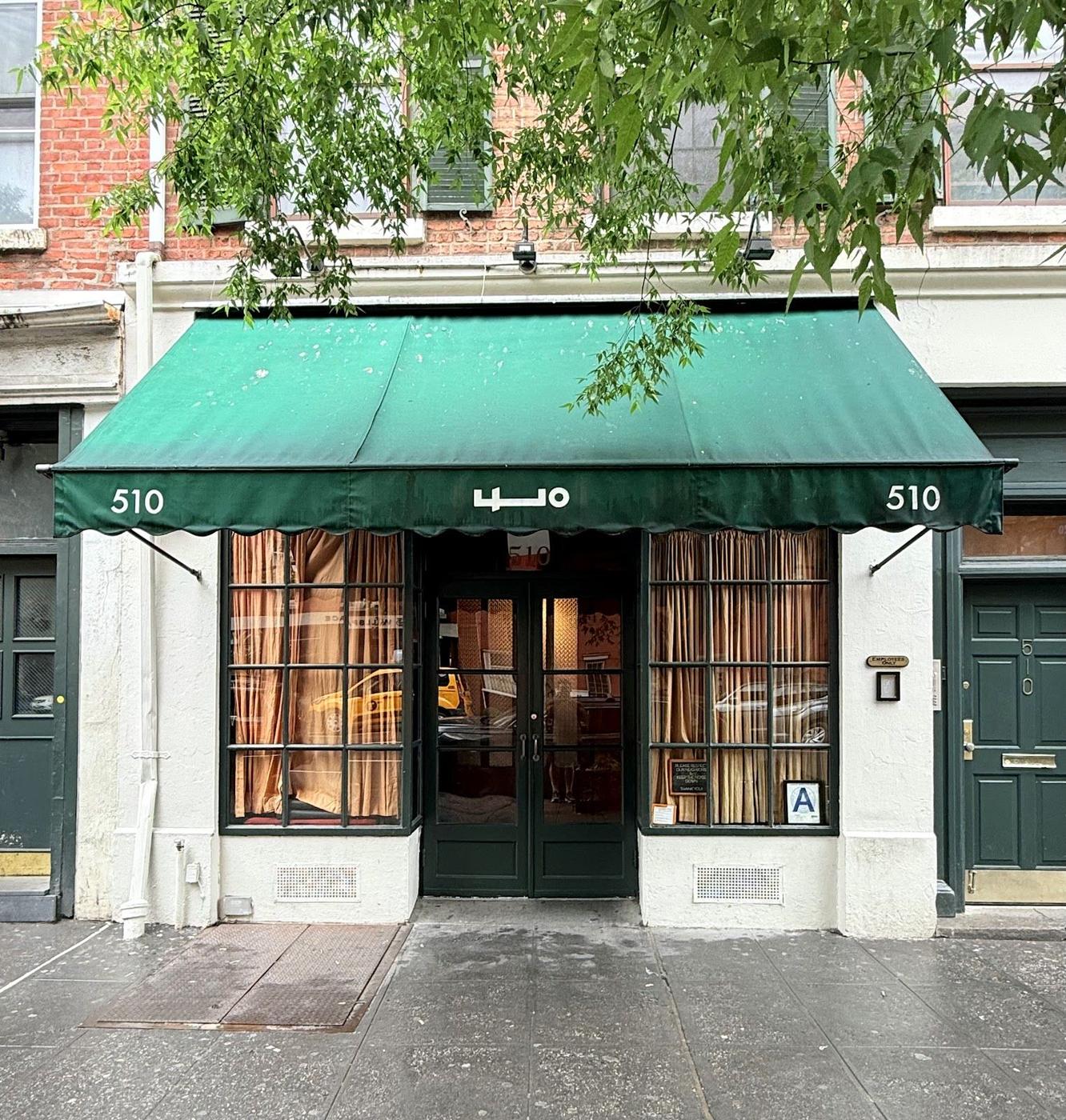
Angel's Share opened in 1993, the work of Tadao "Tony" Yoshida, and for its entire first life it was tucked above his East Village izakaya, Village Yokocho, at 8 Stuyvesant Street. There was no sign for the bar. You walked into the restaurant, found an unmarked door to the side, and stepped into a small, dim room that felt like a secret the neighbourhood had agreed to keep. In an era when New York cocktails largely meant a well vodka and a splash of something, that was close to revolutionary.
What Yoshida imported was not just secrecy but a whole discipline: Japanese bartending, with its reverence for the classics, its precision of measure and stir, and its conviction that hospitality is a craft in itself. Angel's Share is widely credited as one of the bars that sparked the city's craft-cocktail revival, and it introduced a generation of New York drinkers,and, crucially, New York bartenders,to a Japanese approach they would carry into rooms all over the city. Many of the people who went on to define American cocktail culture in the 2000s passed through, or were shaped by, this one small room.
That influence is the core of the case for ranking it first. Plenty of bars are hidden; this is the one that made hiding meaningful. It treated a concealed door not as a marketing gimmick but as a promise,that what waited on the other side would be worth the search, and worth behaving well for once you arrived.
Closure, and a second life on Grove Street
In 2022, the building that housed Village Yokocho, the Sunrise Mart grocery and Angel's Share all closed together, and one of New York's most beloved bars went dark. For a while it looked like the end of an institution. Then Yoshida's daughter, Erina Yoshida,now the bar's sole owner,set about reviving it, and in 2023 Angel's Share reopened, this time at 45 Grove Street in the West Village.
The relocation could have diluted the magic. It didn't. Erina carried the essentials across town intact, including the bar's most famous piece of decoration: the mural of baffled-looking cherubs drifting through a cloudscape, transplanted from the old East Village room to the new one. The house rules came too, and so did the sensibility. What could have been a nostalgia act instead reads as a continuation,the same bar, run by family, in a new but fitting home among the crooked, low-rise streets of the West Village.
The move also carries a quiet symbolism. Angel's Share helped invent a template that New York then exported to the world; that it survived displacement and came back on its own terms is exactly why it still deserves to lead a list like this one.
The rules,and why they matter
Angel's Share is famous for its house rules, which are less about attitude than about protecting the experience. It is walk-in only,no reservations,so getting a seat is a matter of timing and patience. Parties are capped at four, and the bar does not split larger groups across the room or seat you until your whole party has arrived. There is no standing: if there isn't a seat, there isn't a spot. And the room expects you to keep your voice down and let the bartenders work.
To some visitors this reads as strict. To us it reads as the whole point. The rules are what keep Angel's Share intimate in a city that tends to turn every good thing into a queue and a velvet rope. With roughly seventeen seats, the room only works if everyone in it agrees to a certain hush. The constraints are the reason a bar this celebrated can still feel like a place you've stumbled into rather than a checklist stop.
Practically, that means the strategy is to arrive early. Get there when the doors open and you stand a real chance of a seat and an unhurried conversation with the bartender. Arrive at ten on a Saturday and you may wait, or be turned away,not out of exclusivity for its own sake, but because the room is full and standing isn't a thing here.
The room
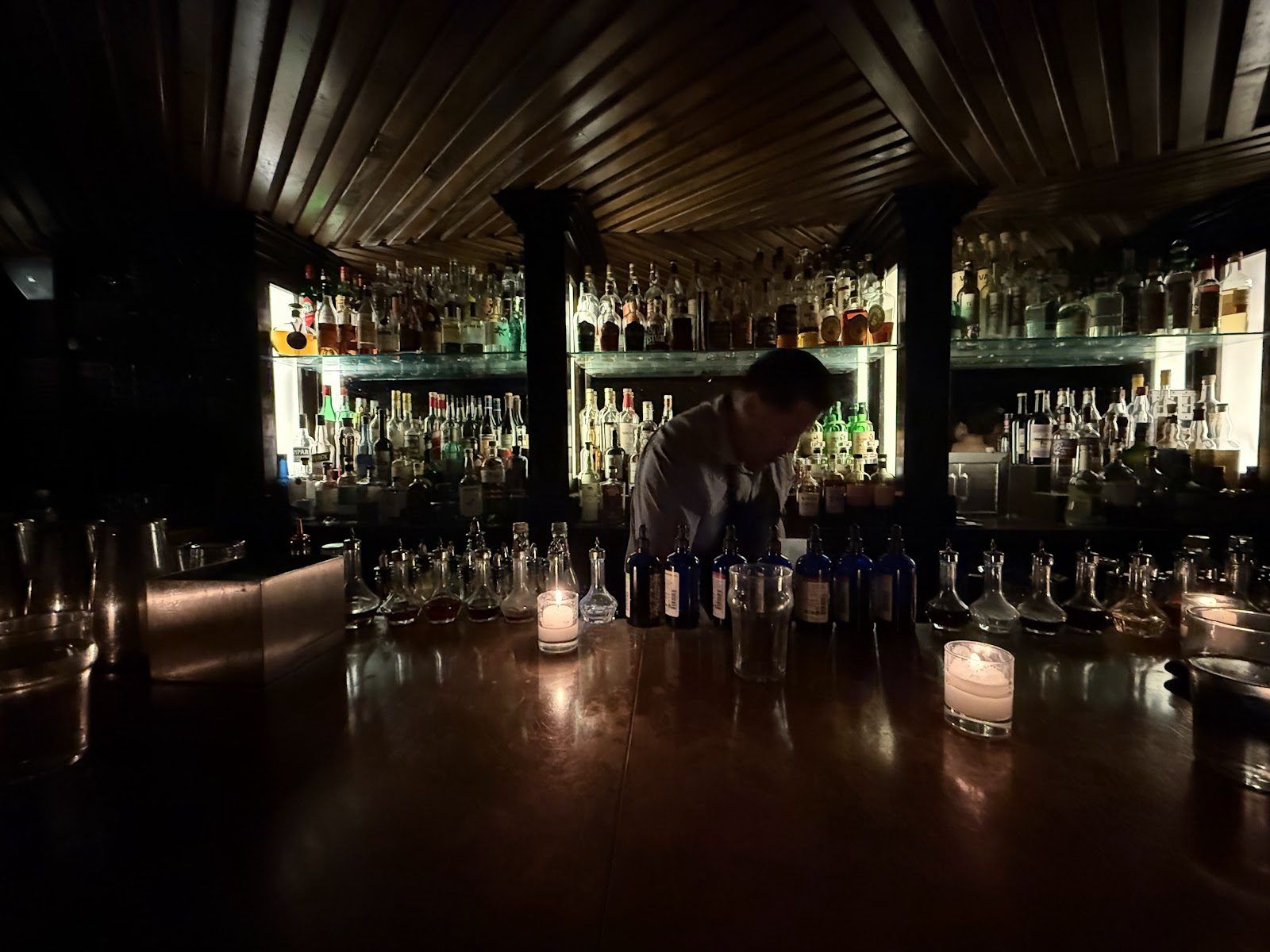
Inside, Angel's Share is small, low-lit and calm. The cherub mural presides over a compact bar and a scattering of seats built for two-to-four-person conversation rather than a crowd. There are no screens, no thumping soundtrack, nothing to compete with the drink in front of you and the person across the table. It is the opposite of a scene bar: a place designed to make an evening feel smaller and closer than the city outside.
The West Village setting suits it. Where the East Village original hid above a bustling restaurant on a side street, the Grove Street location sits among the neighbourhood's quiet, tree-lined blocks,a fitting address for a bar whose entire proposition is that the good stuff is tucked just out of sight.
The cherubs on the ceiling
The bar's name and its most famous feature are of a piece. "The angel's share" is the distiller's term for the portion of spirit that evaporates from the barrel as it ages,the part that, poetically, goes to the angels. Overhead, a mural of baffled-looking cherubs drifts through a painted cloudscape, and when the bar was forced to leave Stuyvesant Street, that mural was carried across town and installed in the Grove Street room. Keeping it was a statement of intent: this is the same bar, not a tribute to it.
Small as that detail is, it captures why Angel's Share has kept its aura through relocation. The bar understood that its identity lived in a handful of specific things,the cherubs, the rules, the hush, the Japanese craft,and it protected all of them. Sit beneath those cherubs today and you're looking at the same painted faces that watched over the East Village original for nearly thirty years.
What to drink
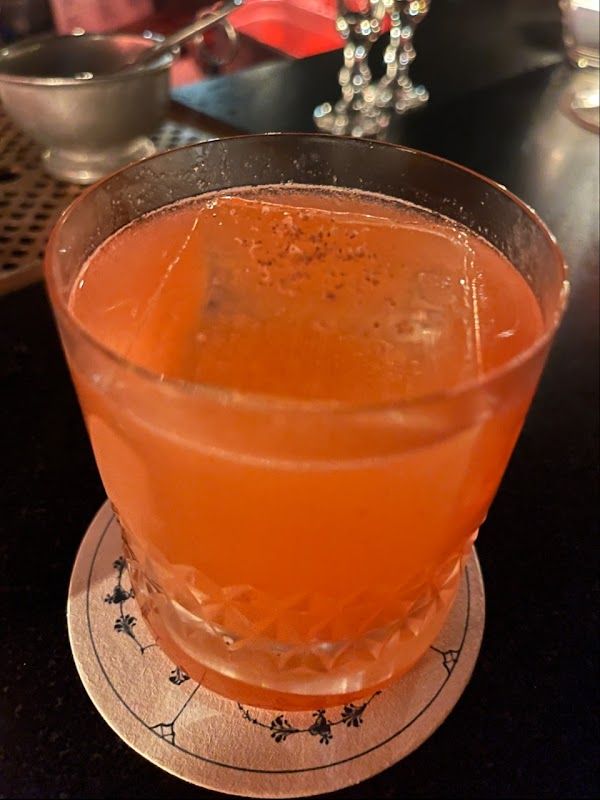
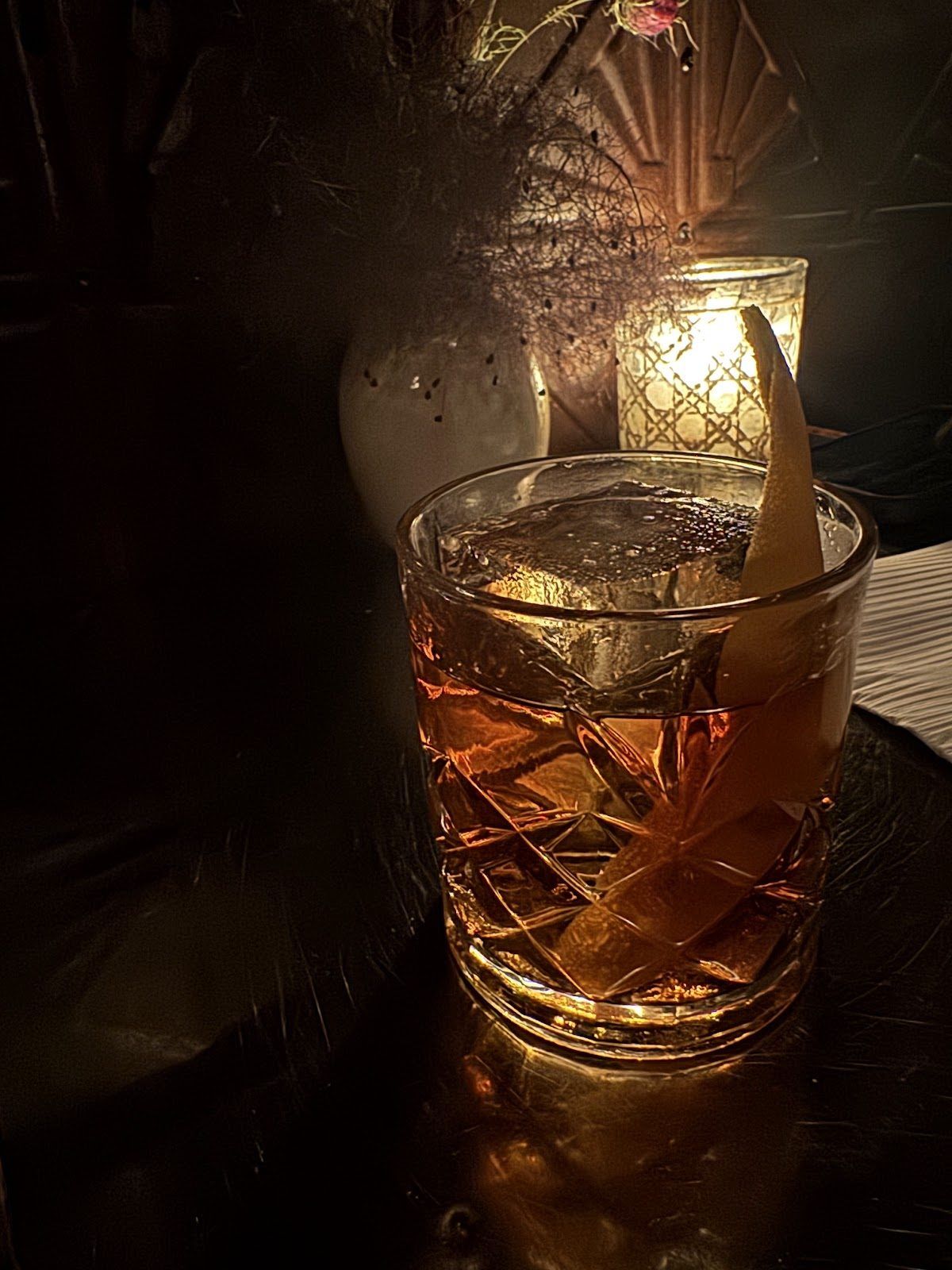
The drinks are where the Japanese lineage shows most clearly: classics built to spec, and originals that lean on technique and balance rather than novelty for its own sake. Two signatures anchor the list. Smoke Gets In Your Eyes,bourbon with aromatised wine, an herbal liqueur, bitters and a veil of smoke,is the drink most associated with the bar and a natural first order. Dirty Dancing shows the more adventurous side of the kitchen: gin with shiso-infused shochu, house-made pickle juice and a whisper of Chinese onion essence, savoury and precise in a way few bars attempt.
Shochu, in fact, is part of the bar's legacy. Angel's Share's Flirtibird is often credited with helping introduce shochu cocktails to New York,another example of the room quietly expanding what the city thought a cocktail could be. If you'd rather be led, put yourself in the bartender's hands and describe what you like; the staff here are practised at reading a table and building to it.
Pricing sits around the $$$ mark for New York, which is fair for the level of care and the size of the room. This is not a volume operation. Each drink is made deliberately, and the pacing of the evening reflects that,one more reason to come early and settle in rather than treat it as a quick stop.
Why it's our No. 1 hidden gem
Rankings like this one can drift toward whichever bar has the most recent award. Angel's Share has plenty of standing,it earned a place on North America's 50 Best Bars in 2026, at No. 31, a striking result for a bar that had to rebuild itself from scratch. But that's not why it tops our list. It leads because it is the archetype: the bar that fused a hidden door, a hushed room and serious Japanese craft into something New York had never quite seen, and then watched that idea travel around the globe.
Every bar on our hidden gems ranking owes a little of its DNA to what Yoshida built in 1993. That a family has kept it alive, and kept it faithful, through closure and relocation only strengthens the case. Angel's Share is a hidden gem in the fullest sense of the phrase,genuinely concealed, genuinely excellent, and genuinely worth the effort of finding.
Japanese bartending, brought to New York
Angel's Share matters not just because it hid, but because of what it was hiding. In 1993, the Japanese approach to cocktails,its reverence for the classics, its precision of stir and shake, its treatment of hospitality (omotenashi) as a craft equal to the drink itself,was largely unknown in American bars. Tony Yoshida's room was one of the first places in New York where you could see it practised: bartenders working with an economy of movement and a seriousness of intent that turned making a drink into something closer to a performance of care.
That mattered far beyond the room's seventeen seats. Angel's Share became a kind of finishing school for the sensibility that would define New York's craft-cocktail era,the belief that a cocktail deserves the same rigour as a plate of food, and that the person on the other side of the bar deserves genuine attention. When people trace the roots of the modern American cocktail bar, this small East Village room is one of the places they keep returning to. Its influence is written into how a whole generation of the city's bartenders learned to think about their work.
A quiet radical, then and now
Part of what makes Angel's Share's story compelling is how much it expanded the vocabulary of American drinking without ever raising its voice. The bar helped introduce New York to shochu, the Japanese distilled spirit, at a time when it was a rarity on Western back bars; its Flirtibird is often credited with helping bring shochu cocktails to the city. Drinks like Dirty Dancing,savoury, layered, built on shiso-infused shochu and house-made pickle juice,showed that a cocktail could be as complex and surprising as anything coming out of a kitchen, years before that idea became commonplace.
The move to the West Village hasn't dulled any of that. If anything, in a city where the hidden bar has become a well-worn marketing device, Angel's Share's sincerity stands out more than ever. It was concealed before concealment was a trend, disciplined before rules were a gimmick, and devoted to Japanese craft when that was genuinely novel. Three decades on, run by the founder's daughter, it remains the reference point against which every other hidden cocktail bar is measured,which is the simplest possible argument for putting it first.
How to visit
Angel's Share is at 45 Grove Street in the West Village. It is walk-in only, so the single most useful piece of advice is to go early in the evening, especially on weekends; the room is small and fills quickly, and there is no standing room to fall back on. Keep your party to four or fewer, arrive together, and be ready to keep the volume low once you're in. Come for the drink and the conversation, not for a scene,that mismatch is the only way to be disappointed here.
It makes a perfect first stop on a West Village evening, or a considered nightcap after dinner nearby. If you can't get a seat, the neighbourhood is thick with alternatives, but few reward patience the way this one does. For more of the city's concealed rooms, see our guide to the best hidden gems in New York, and our full New York bar guide for every other occasion.
What to order
- 01
Smoke Gets In Your Eyes
The signature: bourbon, aromatised wine, herbal liqueur, bitters and smoke.
- 02
Dirty Dancing
Gin, shiso-infused shochu, house pickle juice and Chinese onion essence.
- 03
Flirtibird
A shochu cocktail from the bar that helped introduce shochu drinks to New York.
- 04
Bartender's choice
Describe what you like and let the Japanese-trained bar team build to it.