On the Jardín Centenario, the tree-shaded plaza at the heart of Coyoacán, sits a mezcaleria that has done as much as anywhere in Mexico City to make artisanal mezcal a proper night out rather than a rural curiosity. Corazón de Maguey brands itself, only half in jest, as the international cathedral of mezcal, and while that is a big claim, the room earns the swagger. It belongs to the Los Danzantes group, one of the most important names in the modern mezcal world, and it pairs a serious agave list with contemporary Oaxacan cooking in one of the loveliest settings in the city. It is our number six mezcal bar in the world, and the best place in the capital to make an evening of the spirit at the table.
Where the dive-bar intensity of Bósforo strips everything back to the glass, Corazón de Maguey does the opposite. It gives mezcal a stage, a kitchen and a terrace on the plaza, and treats it as the centre of a full Mexican meal.
Why Corazón de Maguey is ranked here
Corazón de Maguey sits just below the pure tasting temples on our list for a simple reason: it is as much restaurant as mezcaleria, and that is its strength rather than a weakness. For a visitor who wants to understand mezcal in its proper context, alongside mole, tlayudas and the food of Oaxaca, rather than as a lone pour at a bar rail, there is no better introduction in Mexico City. The Los Danzantes pedigree guarantees the mezcal is the real thing, sourced through one of the country's most respected producer networks, and the Coyoacán setting turns a tasting into an occasion.
Culinary Backstreets described it as an upscale mezcaleria specialising in locally sourced, artisanal mezcal alongside excellent food, and one of the most popular places to sample some of Mexico's finest mezcals. That captures the appeal. This is the mezcaleria you take someone to on their first serious night with the spirit, confident that both the drinking and the eating will convert them.
The Coyoacán setting
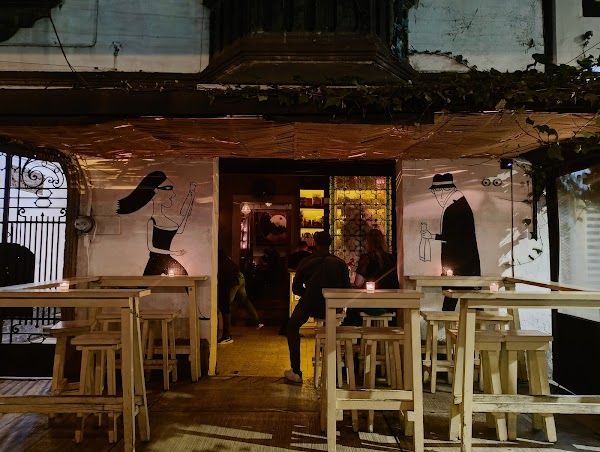
Corazón de Maguey is at Jardín Centenario 9-A, directly on Coyoacán's central plaza, with a terrace that looks out over the square. Coyoacán is one of Mexico City's most beloved neighbourhoods, a colonial district of cobblestones, cafés, weekend markets and the old home of Frida Kahlo, and the plaza in front of the bar is a constant, gentle parade of the city at leisure. The building's architecture has been described as a contemporary reading of the colonial style, echoing the parish church that anchors the same square, and the interior leans into mezcal mythology, themed around Mayahuel, the goddess of the maguey, with printmaker artwork, glass demijohns and folk detail throughout.
The terrace is the signature, and on a warm evening it is one of the great places to drink in the city, a front-row seat on the plaza with a copita of village mezcal in hand. Inside is more intimate and atmospheric, wrapped in the bohemian, prehispanic-tinged decor the group is known for. Either way, the setting does a lot of the work; few mezcalerias anywhere can offer a room this handsome in a square this pretty.
The Los Danzantes story
To understand Corazón de Maguey you have to understand its parent. The Los Danzantes group began with the Los Danzantes restaurant, which opened on this same Coyoacán plaza in 1995, founded by the Muñoz family, the twin brothers Gustavo and Jaime. Two years later, in 1997, the group took a step that would shape Mexican mezcal for decades: it acquired a palenque in Santiago Matatlán, the Oaxacan town that calls itself the world capital of mezcal, and founded its own distillery. From that distillery came Mezcal Los Danzantes and, later, the Alipús line of village mezcals, with Jaime Muñoz running the Oaxaca operation.
Alipús is the key to what makes this bar special. It is a range of single-village mezcals made by a socially minded cooperative of independent mezcalero families across different Oaxacan pueblos, San Andrés, San Baltazar, Santa Ana, San Luis del Río, San Juan del Río and others, each bottling capturing how the spirit changes from one hill and one maker to the next. The insight behind it, that mezcal has terroir as surely as wine does, is now central to how the whole category is understood, and Corazón de Maguey is in many ways the flagship tasting room for that idea. The group's mezcals now reach dozens of countries, and the flagship Los Danzantes restaurant next door on the same plaza is a Michelin Guide listing.
The mezcal
The list is anchored by the group's own labels, the Los Danzantes mezcals and the full Alipús village range, and rounded out with a curated selection of other artisanal, campesino mezcals. The bar even bills itself as home to the first Barra Alipús, a counter built around those village bottlings. For a drinker, this is a gift: you can taste several Alipús mezcals side by side and learn, in a single sitting, how a spirit made the same traditional way in five different villages ends up tasting like five different things. The house pour on the terrace is Alipús, which tells you where the bar's heart is.
This is a group-anchored list rather than a sprawling encyclopedic one in the manner of Bósforo or In Situ, and that is a deliberate choice. What you get is provenance you can trust and a coherent story, from the group's own Matatlán distillery to the cooperative villages behind Alipús, rather than a chalkboard of hundreds of unlabelled rarities. Ask the staff to walk you through the village range and you will come away understanding terroir in mezcal better than almost any other single tasting can teach you.
The food
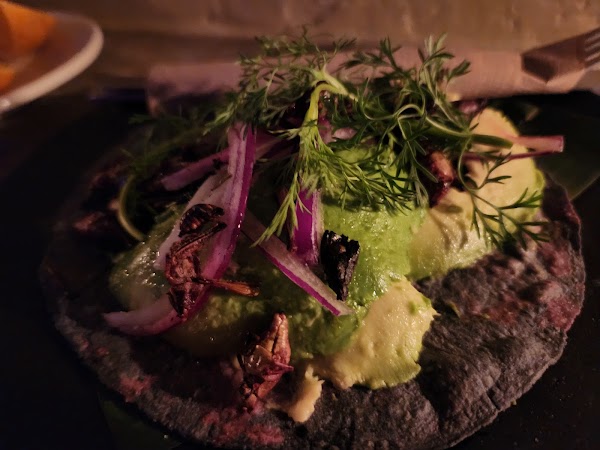
The kitchen is a serious part of the proposition, led by chef Alejandro Piñón and offering a contemporary take on Mexican and especially Oaxacan cooking. The menu is a showcase of the south. Tlayudas come loaded with tasajo, chorizo and chapulines; the three great Oaxacan moles, negro, rojo and verde, appear across the menu, including in enchiladas de tres moles; and there is a genuine appetite for the adventurous, with escamoles, gusanos de maguey and other traditional insect and regional dishes for those who want them. Culinary Backstreets singled out the pescadillas, fried quesadillas filled with shark, and the beef tongue, among its highlights. Guacamole arrives dotted with Oaxacan chapulines seasoned with hoja santa and pasilla mixe.
All of it is designed to sit alongside the mezcal rather than compete with it, and the pairing is the point. A smoky village espadín next to a plate of mole is one of the classic experiences of Mexican gastronomy, and Corazón de Maguey serves it about as well as anywhere in the capital. This is why the bar rewards a full evening: come hungry, order across the menu, and let the food and the mezcal talk to each other.
The cocktails
While the neat pours are the heart of the place, the cocktail list is worth knowing. The Mezcal Tonic, built on young Los Danzantes mezcal, is a house favourite, and the bar makes a well-regarded mezcal Negroni that travel writers reliably recommend, along with margarita variations and mezcal-based takes on Mexican classics. For a guest easing into the spirit, a good mezcal cocktail is a gentler on-ramp than a high-proof wild-agave pour, and Corazón de Maguey builds them with the same quality spirit it pours neat.
A short course in mezcal
Because Corazón de Maguey is such a good teaching bar, the basics are worth having. Mezcal is an agave distillate protected by a Denomination of Origin covering nine Mexican states, with Oaxaca as the heartland. Unlike tequila, which uses only blue Weber agave, mezcal can be made from dozens of agave species; espadín, the cultivated workhorse, accounts for the great majority of production, while wild varieties like tobalá take many years to mature. The signature smoke comes from roasting the agave hearts, the piñas, in conical earthen pit ovens lined with stone before they are crushed, traditionally by a horse-drawn stone tahona wheel, then fermented and distilled. The rural workshop where all of this happens is called a palenque, and the master distiller is the maestro mezcalero.
The single most useful concept here is the one the bar was built to demonstrate: village or single-village mezcal. Because terroir, agave, water and the maker's hand all shift from one pueblo to the next, a mezcal from San Andrés tastes recognisably different from one made the same way in San Luis del Río. That is the whole premise of Alipús, and tasting the range is the fastest way to feel it for yourself. As ever, the spirit is meant to be sipped, not shot, often with orange and sal de gusano alongside.
How to visit
Corazón de Maguey takes reservations, through OpenTable and by phone, which sets it apart from the walk-in mezcalerias higher on our list and makes it the sensible choice for a planned dinner or a group. Book the terrace if the weather is kind and you want the plaza view. Come hungry and treat it as a full meal rather than a quick drink; the food is too good to skip. Ask the staff to guide you through the Alipús village mezcals as a flight, which is the signature experience here. Hours run long, with the kitchen reportedly open from the morning through late evening on most days, but confirm current times before a special trip, as they vary. It pairs beautifully with a wider afternoon in Coyoacán, the markets, the Frida Kahlo house, the cafés on the plaza.
Frequently asked questions
Where is Corazón de Maguey? At Jardín Centenario 9-A, directly on the central plaza of Coyoacán, Mexico City, with a terrace overlooking the square. The flagship Los Danzantes restaurant sits on the same plaza.
Is it a bar or a restaurant? Both. It is a mezcaleria-restaurant, which means you can come for a full Oaxacan meal with a mezcal flight, or simply for drinks and snacks on the terrace. The food is a serious part of the experience.
Do I need a reservation? It is advisable. Unlike the walk-in mezcalerias, Corazón de Maguey takes bookings through OpenTable and by phone, which is the safe move for the terrace, weekends or a group.
What should I drink? Ask for a flight of the Alipús single-village mezcals to taste how the spirit changes from one Oaxacan pueblo to the next. If you prefer a cocktail, the Mezcal Tonic and the mezcal Negroni are house standards.
Who owns it? It is part of the Los Danzantes group, which runs its own distillery in Santiago Matatlán, Oaxaca, and produces the Los Danzantes and Alipús mezcals. That network is why the list is so trustworthy.
Is it open in 2026? Yes, it is operating and taking reservations. Hours vary, so confirm current times before visiting.
The verdict
Corazón de Maguey is the mezcaleria you visit when you want mezcal to be an event rather than an errand. It has the pedigree, through the Los Danzantes distillery and the Alipús village mezcals, the kitchen, through a genuinely excellent Oaxacan menu, and the setting, on one of Mexico City's prettiest plazas. It is not the austere tasting temple that tops our list, and it does not try to be; it is something warmer and more sociable, the place to eat and drink Oaxaca in the capital. For a first serious mezcal night in Mexico City, or simply for one of the loveliest evenings the city offers, it is hard to beat, and it earns its high place on our ranking.