On Avenida Álvaro Obregón, on the border between the Condesa and Roma Norte, a small, candlelit room has been quietly doing the same thing very well since 2009. La Clandestina calls itself the traditional place to drink mezcal in Mexico City, and for the neighbourhood it serves, that is close to the truth. It was taking small-batch, single-maestro mezcal seriously long before the spirit became fashionable, and it still offers one of the warmest, least pretentious introductions to agave in the capital. It is our number seven mezcal bar in the world, and the natural first stop for anyone staying in the Condesa or Roma.
The name means the clandestine one, a nod to the back rooms and hidden palenques where mezcal was made and drunk through the decades when it was a rural secret rather than a global spirit. The bar leans into that history, and the result is a room that feels like a genuine mezcalero's hideaway rather than a designed concept.
Why La Clandestina is ranked here
La Clandestina earns its place not through scale or spectacle but through consistency and character. It is a smaller list than the encyclopedic collections higher on our ranking, but it is chosen with real care, and the room has an intimacy that the bigger, buzzier venues cannot match. For a first-timer, it is close to ideal: knowledgeable staff, a manageable, well-curated selection, and an atmosphere that invites you to slow down and actually taste rather than rush. Culture Trip, listing it among the city's best mezcal spots, made exactly this point, noting that it makes up for a smaller selection with the sheer quality of its products, many of them artisanal.
It is also, importantly, an independent operation with its own point of view. Where our number six, Corazón de Maguey, belongs to the Los Danzantes group, La Clandestina is a project of a different mezcal family entirely, which gives the two bars distinct personalities and makes visiting both a genuine study in contrasts.
The Condesa setting
La Clandestina sits at Avenida Álvaro Obregón 298. That address is worth a note, because Obregón is the spine of Roma Norte, so the bar effectively straddles the line between the Condesa and Roma, two of Mexico City's most walkable, café-and-tree-lined neighbourhoods. The venue brands itself firmly as Condesa, and either way it is in the thick of the city's most pleasant drinking-and-dining district.
Inside, it is small and deliberately atmospheric. Reviewers describe a hole-in-the-wall with a bar up front and candlelit tables scattered through several small back rooms, decorated in the spirit of the traditional spaces where mezcal has always been drunk, right down to plastic garrafas of mezcal on the back bar. There is seating indoors and out. The whole effect is intimate and a little secretive, exactly as the name promises, and it rewards settling in for the evening rather than passing through.
The Mezcales Milagrito connection
A point of accuracy worth making, because it is often muddled online: La Clandestina is a project of the Mezcales Milagrito family, not of the Los Danzantes group. Milagrito is a mezcal brand founded in 2005 in Santiago Matatlán, the Oaxacan town that calls itself the world capital of mezcal, and La Clandestina is in effect its bar in the capital, the place where that family's commitment to traditional, small-batch mezcal meets the public. Some guides have wrongly linked the bar to Los Danzantes and Corazón de Maguey; that is a mix-up between two separate mezcaleria operations, and it is worth setting straight, because the independence is part of what gives La Clandestina its distinct character.
In 2012 the family opened a sister dining room, La Lavandería Nocturna, right next door, and today the two operate as one house, so an evening here can stretch easily from mezcal into a proper meal.
The mezcal
The list is built around traditional, artisanal mezcal from small Oaxacan maestros. The bar's own materials describe a selection of around twenty-five mezcals from different regions of the country, handmade by mezcal masters, though some visitors, including Matador Network, have counted a rather larger range in the forty-to-fifty area. The honest picture is a curated list of somewhere between two and four dozen artisanal mezcals, weighted heavily toward small producers, with the emphasis firmly on quality and provenance over sheer numbers. This is not the place to chase hundreds of unlabelled rarities; it is the place to sit with a handful of carefully chosen bottles and learn to tell them apart.
What sets La Clandestina apart is its commitment to teaching. The bar offers guided tastings and instruction, walking guests through how to hold and use the copita, how to take a first sip, how to separate the aromas from the alcohol, and how the spirit is produced and distilled, all with the explicit aim of dispelling the myths that still cling to mezcal. The staff are repeatedly singled out as unusually knowledgeable, and this is a room where asking questions is welcomed rather than tolerated. For a beginner, that patient, educational bent is worth more than a thousand bottles you do not understand.
The food
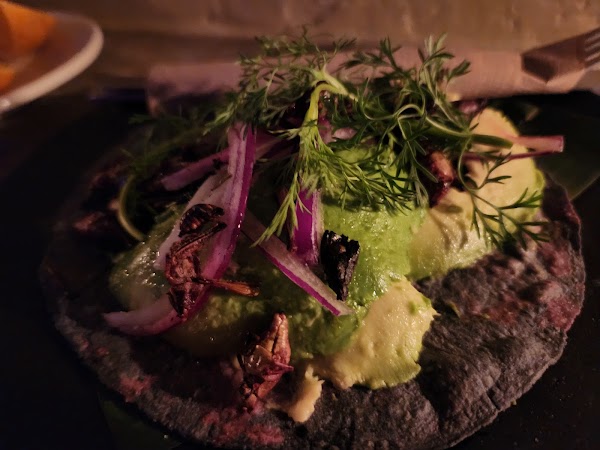
The kitchen keeps to Oaxacan and Mexican bar snacks that partner well with the pours. The menu runs to chalupitas, guacamole with chapulines, esquites, queso fundido and tlayudas, the sort of fatty, savoury, corn-and-chile plates that make a long mezcal session sustainable and that echo the flavours of the spirit's homeland. With the adjoining La Lavandería Nocturna, the food side of the operation can go further, so you are never far from a proper bite. As always with mezcal, a little food between pours keeps the palate sharp and the evening long.
A short course in mezcal
La Clandestina is a teaching bar, so the fundamentals are worth carrying in. Mezcal is a Mexican agave distillate that, unlike tequila with its single blue Weber agave, can be made from dozens of species; espadín is the common cultivated workhorse, while wild varieties like tobalá, tepextate and madrecuishe are prized and slow to mature. It carries a Denomination of Origin protecting production across nine states, with Oaxaca as the heartland and Santiago Matatlán, Milagrito's home town, often called the world capital of mezcal. The signature smoke comes from roasting the agave hearts in earthen pit ovens over wood and hot stones before crushing, traditionally with a stone tahona, and fermenting.
Two legal categories worth knowing are artisanal and ancestral, the latter distilled in clay pots and the former typically in copper, both far more hands-on than industrial production. Good mezcal is sipped neat at room temperature from a wide clay copita or veladora, never shot, often with orange and sal de gusano alongside, and most premium bottles are joven, or unaged, to keep the character of the agave and the place intact. Each small-batch mezcal is traceable to a named maestro, a specific village and a specific batch, and it is precisely that provenance that La Clandestina puts front and centre.
How to visit
Treat La Clandestina as an evening bar; it opens in the evening and runs late, and by most accounts it is a walk-in that fills up, especially at weekends, so arriving earlier gives you the pick of the candlelit back rooms. Come with curiosity rather than a fixed order and lean on the staff, whose knowledge is the real draw; ask for a short guided tasting if you are new to mezcal and let them build it around what you like. Pair the pours with a few Oaxacan snacks to keep the palate fresh. And because the exact hours and policies shift, confirm before a special trip. It sits perfectly within a Condesa or Roma evening, an easy walk from dozens of the city's best restaurants and bars.
Frequently asked questions
Where is La Clandestina? At Avenida Álvaro Obregón 298, on the border of the Condesa and Roma Norte in Mexico City. It brands itself as Condesa and sits in the heart of the city's best drinking-and-dining district.
Who owns it? It is a project of the Mezcales Milagrito family, whose mezcal brand was founded in 2005 in Santiago Matatlán, Oaxaca. Despite what some guides say, it is not part of the Los Danzantes group.
How big is the mezcal list? Reports range from around twenty-five, by the bar's own account, up to forty or fifty per some visitors. Either way it is a curated, quality-first selection of artisanal mezcal from small Oaxacan producers.
Is it good for beginners? Very. The staff are known for patient, knowledgeable guided tastings that teach you how to taste mezcal and how it is made, which makes it one of the best first stops in the city.
Do I need a reservation? It reads as a walk-in bar that gets busy in the evenings, so arriving earlier at weekends is wise. Confirm current policy before a special trip.
Is there food? Yes, Oaxacan snacks like tlayudas, chalupitas and guacamole with chapulines, and the adjoining sister dining room La Lavandería Nocturna extends the kitchen further.
The verdict
La Clandestina is the neighbourhood mezcaleria done right: small, warm, independent, and genuinely committed to teaching. It will not overwhelm you with hundreds of bottles, and that is exactly its charm; instead it hands you a carefully chosen list, a knowledgeable guide across the bar, and a candlelit room to linger in. For anyone staying in the Condesa or Roma, it is the obvious and excellent first stop on an agave education, and a gentler counterpoint to the dive-bar intensity of Bósforo. Sixteen years in, it remains one of the most reliable and likeable mezcalerias in Mexico City, and it earns its place on our list.