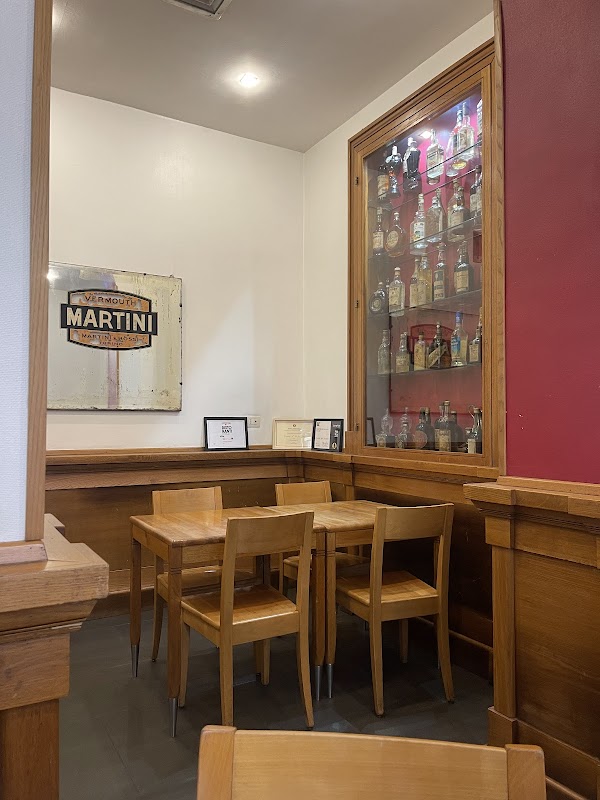
Il Goccetto, "a little sip", is Rome's connoisseur wine bar, and one of the most beloved after-work rooms in the city. Under a painted coffered ceiling, in a 16th-century building that still wears the faded "Vino e Olio" sign of its predecessor, several hundred labels line the walls and a chalkboard lists the day's wines by the glass. Romans who take their wine seriously but their surroundings lightly have been standing two-deep at this counter since 1983.
It sits on Via dei Banchi Vecchi, a picturesque lane in the centro storico a short walk from Campo de' Fiori and Piazza Navona, near Via Giulia and the Tiber, directly across the street from the two-Michelin-star restaurant Il Pagliaccio. The setting is quintessentially Roman: a dark, cosy, bottle-lined room that feels smaller than it is because wine is stacked wall to wall and above the tables, opening in warm months onto a stretch of pavement where drinkers spill out with a glass in hand.
Forty years of an idea
Il Goccetto was opened in 1983 by Anna and Sergio Ceccarelli, wine enthusiasts who set up shop in a Rome that was only just beginning to explore high-quality wine, three years before Stefano Bonilli founded the Gambero Rosso guide in 1986. That timing matters, because it places Il Goccetto among the true pioneers of the modern Roman wine bar, in the same lineage as Cavour 313 and Cul de Sac. The Ceccarellis have remained the family behind it and celebrated the bar's fortieth anniversary around 2023, four decades of running the same room with the same idea: good wine, chosen with care, poured without ceremony.
The premises came with history attached. The building is 16th-century, its ceiling a painted, coffered survivor of an earlier age, and the shop it replaced was a vini e olio, one of the old Roman stores that sold food and bulk wine, whose banner still hangs above the door. (You will see some sources reach for more dramatic backstories, dating the building precisely or attaching it to a famous architect or a bishop's palazzo; those claims are not reliably documented, so we leave them aside. The verifiable heritage, a Renaissance building, a preserved old sign, four decades of the Ceccarellis, is more than enough.)
The wine, and the by-the-glass ritual
The heart of Il Goccetto is the by-the-glass list, chalked on a board and rotated constantly, the producers featured change month to month, and a good handful of wines are available by the glass at any time. The cellar behind them is deep: sources cite anywhere from several hundred to eight hundred–plus labels, and the honest answer is that the number is large and always shifting, so we will not pretend to a precise count. What is consistent is the sensibility. The emphasis is on small artisan Italian producers and unexpected bottles, an Italy mapped north to south, with lesser-known denominations and grape varieties given room, alongside a serious French presence that runs to Burgundy, Champagne and Bordeaux.
Tellingly, the house resists the fashionable labels. As Gambero Rosso's own writers have put it, at Il Goccetto "there's no natural wine, conventional wine, industrial wine, or commercial wine, only wines chosen with heart," by growers who have put in the years in the vineyard. So while the by-the-glass board will happily include a low-intervention bottle, it is not a "natural wine bar" in the doctrinaire sense; it is simply a bar that pours good wine. Prices by the glass are famously fair for the quality, this has never been an intimidating place to drink well, though, as with everything on the site, we leave exact figures off because they change.
The food is, deliberately, an appendix to the wine rather than a menu in its own right. Expect carefully chosen Italian cheeses and high-quality cured meats with rustic bread, and a handful of simple plates that reward asking what is good that day, sweet-and-sour wild onions (lampascioni), a plate of apple, fresh cheese and pine nuts, the rustic stuffed pie known as tiella. The AFAR shorthand is the right one: order the cheese plate, and let the wine lead.
A Roman institution, warts and all
Il Goccetto's reputation runs surprisingly deep for so unassuming a room. It is repeatedly named among the best places to drink wine in the city, the Rome food writer Katie Parla has called it "maybe my favorite place to drink wine in Rome", and it is threaded through the story of Italian wine criticism itself. It is said, in the hedged phrasing Gambero Rosso uses about its own legend, that the idea for the Tre Bicchieri award was dreamed up here; we pass that along as the affectionate lore it is, not documented fact. Less ambiguously, the influential critic Daniele Cernilli, a co-founder of the Gambero Rosso guide, described Il Goccetto as his informal "university of wine," and in his memoir called the packed room "più una bolgia dantesca", more a Dantean throng than a hushed tasting temple. That is exactly the point. This is not a solemn wine cathedral; it is a busy, joyful, slightly chaotic bar where serious wine happens to be the thing everyone is drinking.
The rhythm of the evening is part of the pleasure. Arrive around the Roman aperitivo hour and you may find locals reading the paper or playing a quiet game over an early glass; a little later the room fills with young professional Romans and the pavement outside turns into what one guide called "an impromptu street party." It is one of the city's most enjoyable after-work hangs precisely because it flexes, a calm early glass or a shoulder-to-shoulder scene, depending on when you come.
The shape of an evening
Part of Il Goccetto's charm is how the room changes with the hour. Arrive early, around the start of the Roman aperitivo, and you may find a handful of locals nursing a first glass over a newspaper or a quiet game, the pace unhurried and almost domestic. Stay, or come back later, and the room fills and warms and tips toward a young, professional Roman crowd, the noise rising and the pavement outside filling up. That flexibility is exactly what you want from an after-work bar: it can be a calm decompression at six or a proper night out at nine, and it never feels like a different place, just a busier version of the same one.
The move, however you come, is the same. Take a stool or a patch of counter, look at the chalkboard, and ask what the staff are excited about; the by-the-glass list is where the fun is, and trusting it rewards you with grapes and denominations you would never pick blind. Order a plate of cheese or salumi to anchor the wine, the food is chosen with the same care as the bottles, even if it is intentionally simple, and then let one glass lead to the next. There is no dress code, no reservation, no ceremony; the whole design of the place invites you to stay a little longer than you meant to, which is the highest compliment you can pay a wine bar.
One of Rome's wine-bar pioneers
Il Goccetto belongs to a small founding generation of Roman wine bars, and its place in that lineage is part of what makes it matter. When the Ceccarellis opened in 1983, drinking good wine by the glass in a casual setting was still a novel idea in Rome; the city's serious wine culture was largely a matter of shops selling bottles and bulk. Il Goccetto sat alongside a handful of pioneers, the venerable Cavour 313, the tiny Cul de Sac near Piazza Navona, that turned the enoteca into somewhere you could actually sit and drink. The Trimani wine bar, an offshoot of a merchant family trading since the early nineteenth century, would follow later. Together they built the template for the modern Roman wine bar, and Il Goccetto has outlasted the novelty to become, in the words of more than one guide, "a Roman institution."
Its influence on the wider Italian wine world runs deeper than its size suggests. The critic Daniele Cernilli, one of the founders of the Gambero Rosso wine guide, and for decades among the most influential palates in the country, has spoken of Il Goccetto as a kind of informal school, his "university of wine," and remembered it in print not as a hushed temple but as a joyous, packed room. That is the paradox at the centre of the place: it is both genuinely serious about wine and entirely unserious about atmosphere. You can spend an evening here learning something real about Italian viticulture, one chalkboard pour at a time, while standing shoulder to shoulder with strangers in a room that feels more like a party than a tasting. Few wine bars anywhere hold those two things together as well.
Via dei Banchi Vecchi and the old centre
The street itself repays a moment's attention. Via dei Banchi Vecchi, "the old banks", takes its name from the Renaissance, when Florentine bankers set up along here in the papal financial district; it runs through one of the most atmospheric pockets of the centro storico, close to Via Giulia, Campo de' Fiori and Piazza Navona, roughly parallel to the Tiber. It is a lane of workshops, small palazzi and doorways, and Il Goccetto's preserved "Vino e Olio" sign fits it perfectly, a piece of the older, working street still hanging in place. Directly opposite sits the two-Michelin-star restaurant Il Pagliaccio, an odd and pleasing juxtaposition, high gastronomy across the cobbles from a bar where the point is a good, cheap glass and a plate of cheese. A few steps away is the beloved supplì takeaway Supplizio, which means a fried-rice-ball chaser is never far off.
That location makes Il Goccetto an ideal hinge for an evening in old Rome. It is the kind of place you fold into a walk through the centro storico rather than make a special pilgrimage to, a glass before dinner, a nightcap after, or simply the whole evening spent drifting between the counter and the pavement outside. In warm months, that pavement becomes the room's overflow, and the scene the guides describe as "an impromptu street party" spills across the lane. It is, in the truest sense, a wine bar of its neighbourhood, and the neighbourhood is one of the loveliest in Europe.
When to go, and what to order
Il Goccetto keeps wine-bar hours: midday and evening service, generally closed on Sundays and without a Monday lunch, and it takes no reservations. For the after-work slot, aim for the early evening, order a glass of whatever the counter recommends from the chalkboard, trusting the staff is always the right call here, and add a plate of cheese and salumi to go with it. If the by-the-glass board tempts you toward a second and third pour, that is entirely the intended effect. For a fuller Roman wine evening, our Rome after-work list pairs it naturally with Monti's Ai Tre Scalini, and the wider Rome bar guide maps the rest of the city.
It ranks fourth on our list, and only just behind Ai Tre Scalini, for the narrowest of reasons: it skews a shade more oenophile-destination and a shade less pure neighbourhood local. But as a glass of wine after work in Rome, Il Goccetto has few equals anywhere on this ranking, a forty-year institution that still feels like a secret hidden in plain sight.
What to order
- 01
A by-the-glass pour
From the daily chalkboard, trust the counter's recommendation.
- 02
The cheese plate
Carefully chosen Italian cheeses with rustic bread.
- 03
A tagliere of salumi
High-quality cured meats to keep the wine company.
- 04
An artisan Italian bottle
Ask for a lesser-known grape or denomination.
Sources: Gambero Rosso International; Star Wine List; Katie Parla; AFAR. Opening year (1983) and ownership verified against these; the wine count is given as a range because sources vary, and the Tre Bicchieri origin is reported as local legend, not documented fact.