The local view
Craft beer in Berlin, properly explained
The beer named after this city nearly died in it. More than 200 Berlin breweries made Berliner Weisse in the nineteenth century, the tart wheat beer French troops reportedly called the Champagne of the North. By the 2000s it survived mostly as a syrup-sweetened novelty for coach parties.
The rescue came from odd directions. Three American homebrewers crowdfunded a brewery into a Wedding corner bar, a Kreuzberg market hall handed its cellar to a tiny brewhouse, and BRLO stacked shipping containers into a working brewery beside Gleisdreieck park.
The result is a scene that lives in the kiezes rather than on one polished strip. Kreuzberg and Friedrichshain keep the veteran bars, Neukölln pours the wild fermentations, and Wedding brews more of the city's interesting beer than its quiet streets let on.
Our ranking below covers the rooms actually worth a U-Bahn ride. This guide explains where they cluster, how to move between them, and why a 3 percent sour is still the most Berlin order on any tap list.
Kreuzberg and Gleisdreieck
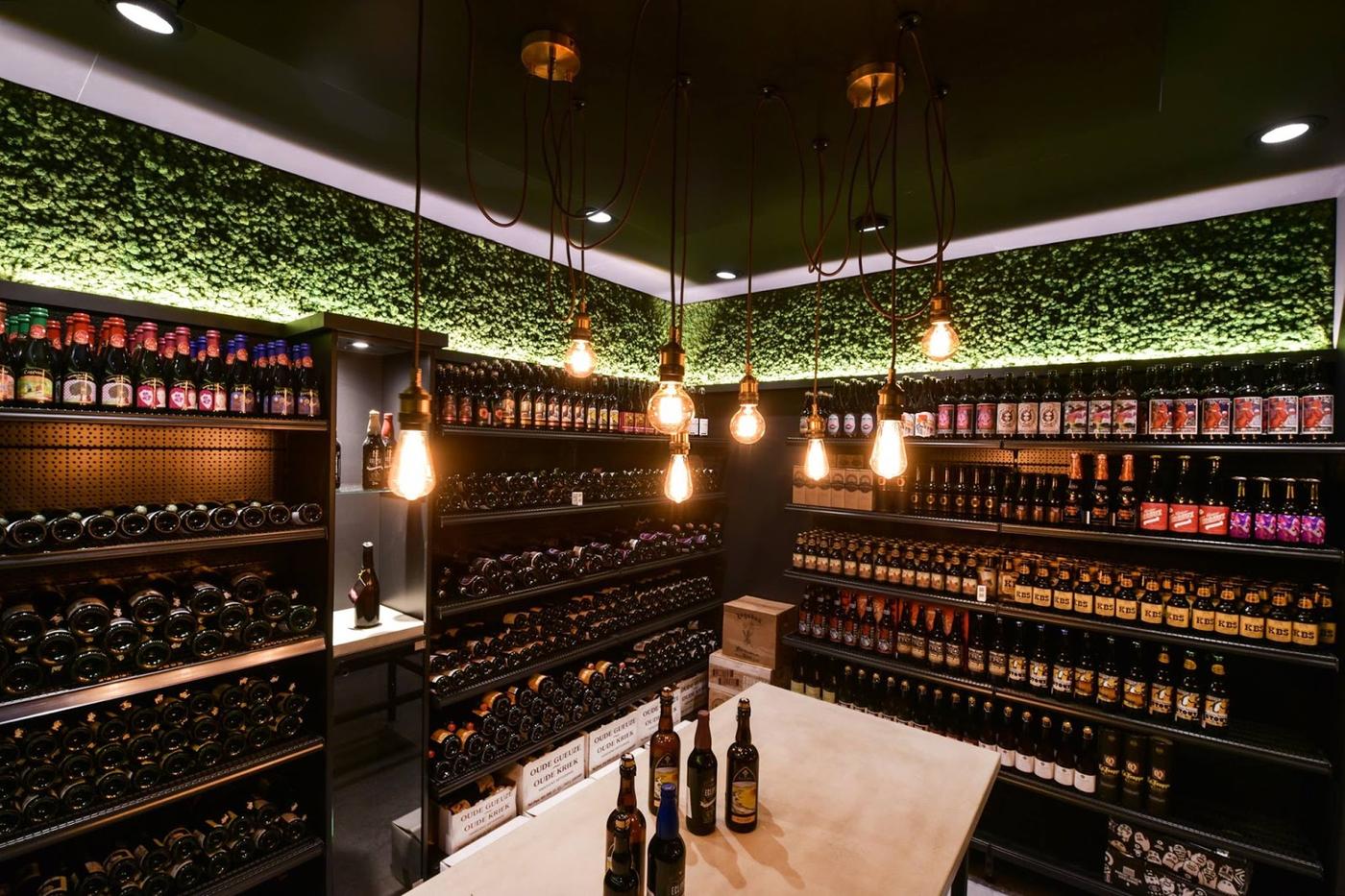
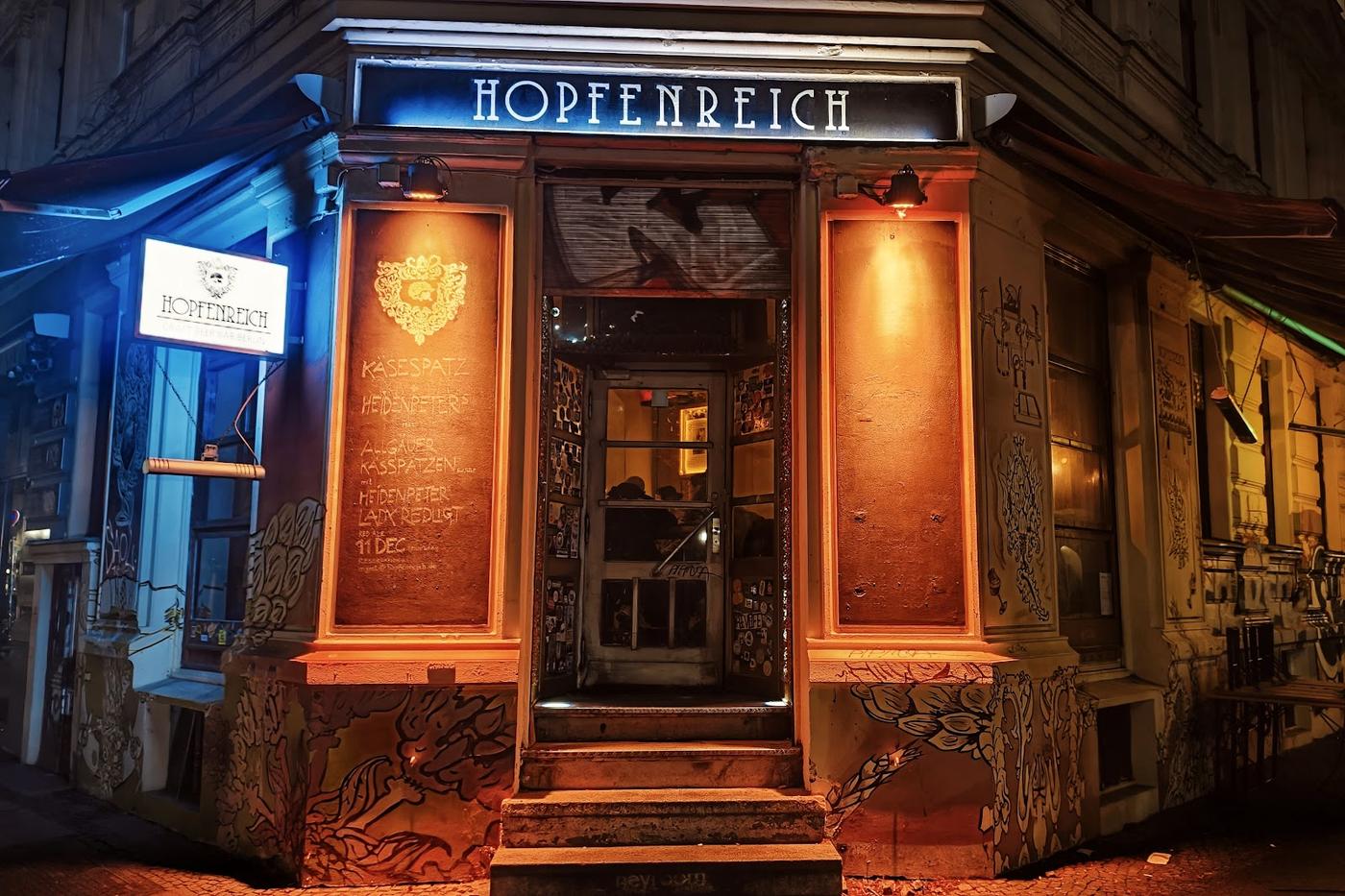
Kreuzberg holds the scene's history and its widest spread. Hopfenreich opened on Sorauer Straße in the Wrangelkiez as one of the city's early dedicated craft beer bars, and it still runs a rotating board of local and European taps a short walk from U1 Schlesisches Tor.
Ten minutes away on Eisenbahnstraße, Heidenpeters brews in the cellar of Markthalle Neun and pours upstairs at a plain wooden counter. Arrive on a market day and you can pair the beer with whatever the food stalls are cooking; U1 Görlitzer Bahnhof is the closest station.
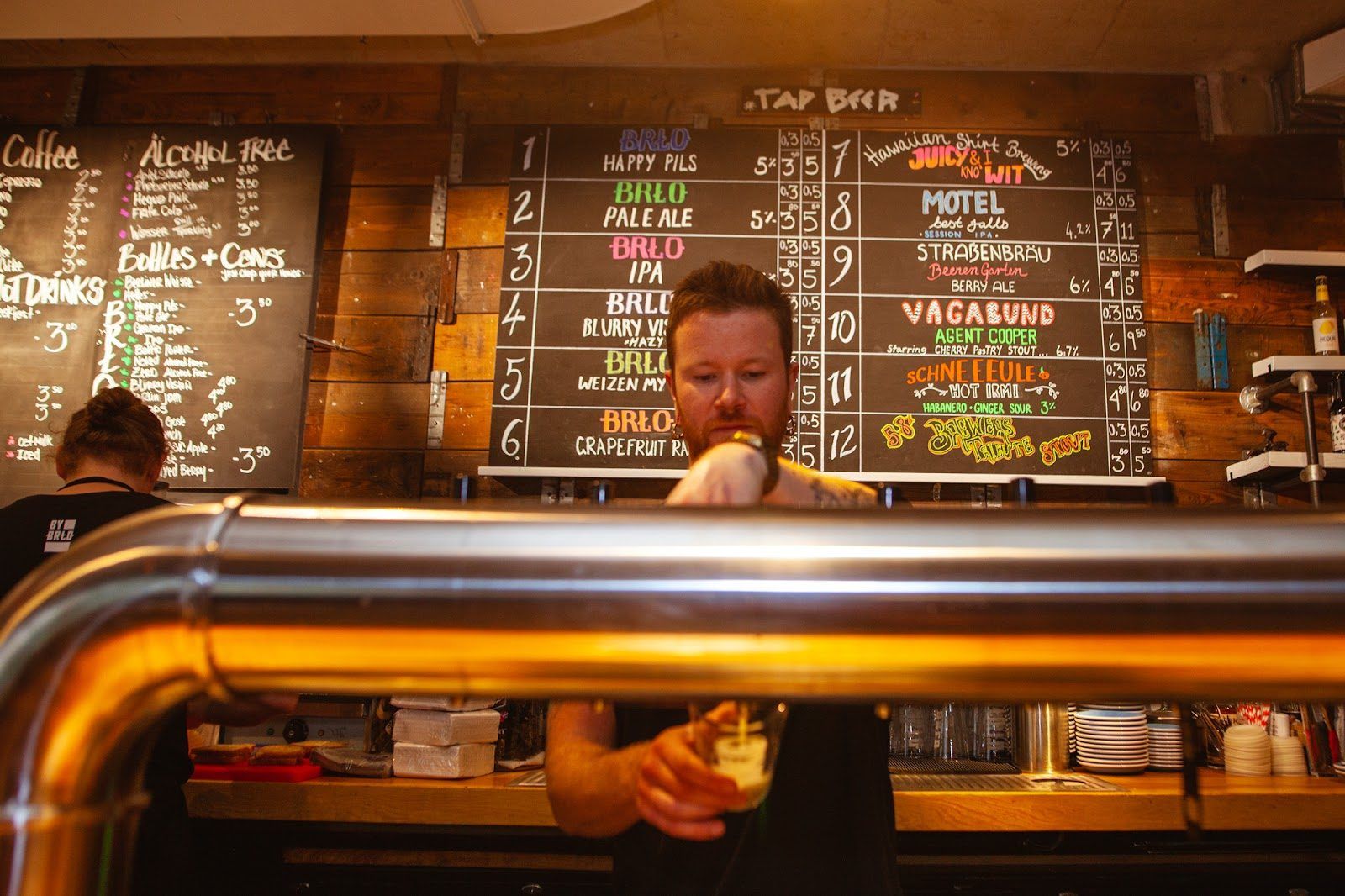
On the district's western edge sits BRLO Brwhouse, a brewery, restaurant and bar assembled from stacked shipping containers next to Gleisdreieck park. Architects GRAFT completed it in 2016 as a structure four containers long and three high, built so it could be dismantled and rebuilt elsewhere. U1, U2 and U3 trains all stop at Gleisdreieck, practically at the door.
Friedrichshain
Friedrichshain's beer life concentrates in the streets around Boxhagener Platz. Hops & Barley on Wühlischstraße is a proper house brewery, with copper kit gleaming behind the bar and the beer made a few metres from your glass.
The board sticks to German classics done carefully, a house lager, a Dunkel and a wheat beer, rather than chasing novelty. That suits a kiez that drinks locally and stays out late.
Reach it with a ten-minute walk from the S and U interchange at Warschauer Straße, or take a tram into the middle of the quarter.
Neukölln
Neukölln is where Berlin's beer gets strange, in the best sense. The Muted Horn on Flughafenstraße keeps a long, constantly changing tap list, and it treats lambic and mixed-fermentation beers as seriously as the hoppy crowd-pleasers.
The bar anchors a kiez dense with late rooms and Spätis, so a night here rarely ends at one address. U8 Boddinstraße puts you within a few minutes' walk of the door.
Wedding
Wedding is the brewing district most visitors never reach. Vagabund Brauerei, started by three American homebrewers and funded through one of Europe's first brewery crowdfunding campaigns, opened its taproom on Antwerpener Straße by U6 Seestraße in 2013. Expect around six rotating taps, backers' names written on the doorframe, and a house policy that welcomes food carried in from neighbouring kitchens.
Its larger Kesselhaus site occupies a former lightbulb factory on Oudenarder Straße. One short U6 hop south, Eschenbräu brews a seasonal calendar of unfiltered beers on Triftstraße, poured in a basement bar and a leafy courtyard near the Wedding S-Bahn and U-Bahn interchange.
The district's wider north also feeds the Berliner Weisse revival. Schneeeule, which ferments its Weisse with Brettanomyces in the traditional bottle-conditioned way, brews near Tegel under brewmaster Ulrike Genz.
Mitte's northern edge
Where Mitte shades into Prenzlauer Berg, Kaschk holds a corner of Linienstraße with a split personality. It runs as a coffee bar through the day and a craft beer bar at night, with shuffleboard in the basement and BRLO closely involved behind the taps.
U2 Rosa-Luxemburg-Platz is the nearest station, and Prenzlauer Berg's own bars are an easy walk uphill. It makes a sensible first stop before an evening heads east or south.
What makes a great craft beer bar in Berlin
The first test is the tap list's postcode. Berlin has enough good independent breweries, from BRLO and Heidenpeters to Schneeeule, Berliner Berg and Brauhaus Lemke, that a bar leaning entirely on imports has made a choice worth questioning.
The second test is rotation. The strongest rooms change their boards constantly and can tell you what the brewer was aiming for, which matters in a city where a lambic and a Landbier can sit on neighbouring taps. The Muted Horn's ever-changing list and Vagabund's six rotating lines set the standard here.
Brewing on site earns extra credit. Hops & Barley makes its beer behind the bar, Heidenpeters ferments under a working market hall, and Eschenbräu pours steps from its own tanks, which keeps the beer fresh and the story honest.
Price honesty counts too. Every drinker here knows the Späti around the corner sells cold bottles for small change, so a bar has to justify the difference with condition, glassware and knowledge rather than attitude.
Finally, the best Berlin beer bars still behave like kiez bars. They tolerate long evenings, dogs and unhurried conversation, and they give a 3 percent Weisse the same respect as a double IPA. A showroom with taps would not survive a Berlin winter.
Planning your night
Most craft beer bars here are evening rooms, while brewery taprooms often open earlier at weekends. Check current hours before crossing town, since Berlin venues adjust them with the seasons.
Summer redraws the map. Eschenbräu's courtyard and the garden seating at BRLO Brwhouse make Wedding and Gleisdreieck the warm-weather picks, and Berlin Beer Week fills August with tastings, tap takeovers and beer boat tours. Winter pushes the crowd back into small rooms, which is when cellar bars like Heidenpeters' counter above the market floor come into their own.
Booking is rarely part of the culture, because bars run on a first-come basis. Reserving makes sense for the restaurant side of BRLO Brwhouse if you are a group; everywhere else, turning up before the post-work rush is the whole strategy.
Etiquette is simple. Order at the bar or run a tab depending on the room, tip by rounding up, and never rush a table mid-conversation, because nobody will rush yours.
The U-Bahn does the heavy lifting between kiezes: the U1 links Kreuzberg's bars to Gleisdreieck, the U8 serves Neukölln, and the U6 runs straight up to Wedding's breweries. Check last services on the BVG network before committing to a final round.
Berlin's craft beer scene is the opposite of a showpiece district, and it is better for it. The essential circuit runs Kreuzberg for history and BRLO's containers, Neukölln for The Muted Horn's fermentation obsessives, and Wedding for the breweries doing the actual work.
Give one evening to the U1 corridor and another to Wedding, and order the unsweetened Berliner Weisse even if the first sip argues with you. The venues at the top of our ranking earn their places by pouring the city's own beer in rooms that still feel like Berlin. That combination is rarer than it sounds.