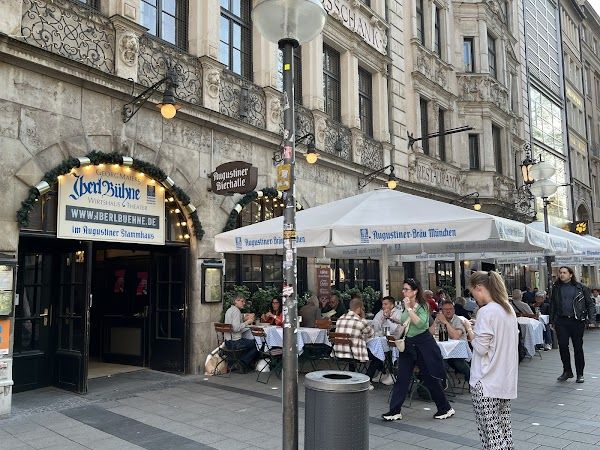
Craft, in the modern sense, is not the only kind of greatness. Under the chestnut trees of the Augustiner-Keller, one of Munich's oldest and largest beer gardens, a wooden cask of Edelstoff is tapped and a litre of the finest lager in Germany is poured. This is beer at its most timeless, and, in its own way, its most perfect.
Why Augustiner-Keller is our No. 12
We include the Augustiner-Keller on our world craft beer ranking to make a point: that a reference-standard lager, poured with reverence in a landmark beer garden, is every bit as worthy as the rarest sour or the hoppiest IPA. Munich's beer culture is one of the glories of the drinking world, and no name in it commands more quiet respect than Augustiner. The Keller is where that beer is at its best.
It ranks twelfth because it combines a genuinely great beer with a setting and a ritual that exist almost nowhere else. This is not craft as novelty; it is craft as tradition, centuries of it, expressed through a single, deceptively simple Helles. To sit here with a Mass in hand as the light fades through the chestnut leaves is to understand a whole philosophy of beer, and it earns its place among the world's best without brewing a single hazy IPA.
Augustiner: 1328 and independence
The beer in your glass comes from an extraordinary lineage. Augustiner-Bräu was established in 1328 and is Munich's oldest brewery, and, crucially, its only big brewery to have remained independent of international corporate ownership. Since 1996 a majority stake has been held by a charitable foundation, the Edith-Haberland-Wagner Foundation, which is precisely why Augustiner has never been swallowed by a multinational and never needed to chase growth or fashion.
That independence is not a marketing story; it is the whole reason Münchners revere the brand. Augustiner famously refuses to advertise aggressively, resists modernising for its own sake, and lets the beer speak for itself. In a world of relentless brand-building, a nearly seven-hundred-year-old brewery that simply makes excellent beer and declines to shout about it has become, paradoxically, the connoisseur's and the local's choice. The Keller is one of the great places to drink the result.
The Keller: an 1862 cellar and a great garden
The Augustiner-Keller sits on Arnulfstrasse, near Munich's Hauptbahnhof, and it is built on a lagering cellar dating to 1862, the kind of deep, cool cellar in which lager beer was matured in the age before refrigeration. Above it spreads one of Munich's oldest and largest beer gardens, a vast expanse of benches shaded by mature chestnut trees, whose leaves were traditionally planted to keep the cellars below cool.
The result is one of the most atmospheric drinking spaces in Europe. On a warm evening the garden fills with thousands of people, office workers, families, students, tourists, all mixed together at long communal tables in the great democratic ritual of the Munich beer garden. There is a more formal restaurant too, but the garden is the heart of the place, and it captures something essential about the city: conviviality, tradition and very good beer, all in the open air. Few sounds capture Munich better than the murmur of a thousand conversations under the chestnut leaves, punctuated now and then by the collective cheer that goes up as a fresh cask is tapped.
Hell, Edelstoff and the wooden cask
The beer to drink is Augustiner Lagerbier Hell, widely regarded as the benchmark Munich Helles, a pale lager of such balance and drinkability that its apparent simplicity is the entire point. There is nothing to hide behind in a Helles; it is all clean malt, gentle bitterness and endless refreshment, and Augustiner's is the one many consider the finest of all. For something a touch stronger, the Edelstoff is a premium pale lager with a little more body and richness.
What makes the Keller special is how the beer is served. In the warmer months, Edelstoff is drawn straight from wooden casks, the Holzfass, a traditional method that is increasingly rare and that gives the beer a soft, fresh, almost creamy character you cannot get from a modern keg. Watching a cask tapped and a litre Mass filled and carried across the garden is part of the experience, and it is one of the reasons beer lovers travel to Munich specifically to drink here.
The ritual of the beer garden
To drink at the Augustiner-Keller properly is to take part in a ritual that is centuries old. You order a Mass, the one-litre glass that is the traditional Munich measure, find a spot at a communal table, and settle in. In a true Bavarian beer garden you are traditionally allowed to bring your own food, spreading out bread, cheese and radishes on the table, though the Keller's kitchen also serves the full range of classic Bavarian fare. The pace is unhurried; the point is to stay, to talk, and to let the evening unfold.
That communal, open-air, deeply social way of drinking is one of humanity's great contributions to beer, and Munich does it better than anywhere. The Augustiner-Keller, as one of the oldest and largest gardens pouring the city's most revered beer, is close to the platonic ideal of it. For a visitor, an evening here is not just a drink but an education in what beer can be when it is woven into the daily life of a city.
Maxvorstadt and getting there
The Keller sits on Arnulfstrasse in the Maxvorstadt district, a short walk from Munich's central station, which makes it one of the easiest of the great beer gardens to reach, you can be here within minutes of stepping off a train. That accessibility, combined with its size, means it rarely feels closed off or hard to get into, even when it is busy; there is almost always room at a table somewhere under the trees.
For a beer traveller, the Keller pairs naturally with Augustiner's other venues, the more basic Bräustuben beside the brewery itself, and the ornate Augustiner-Grossgaststätten flagship hall in the old town, as well as with the monastery beer of Andechser am Dom nearby. Together they map the traditional, lager-centred greatness of Munich beer, of which the Keller garden is the warmest expression.
Why the world reveres Munich lager
It can be hard for drinkers raised on hop-forward craft beer to understand why a simple pale lager inspires such devotion, until they taste a great one, fresh, at its source. Munich Helles is one of the most technically demanding beers in the world precisely because it has nowhere to hide: no big hop aroma, no barrel character, no sweetness to mask a flaw, just malt, water, hops and yeast in perfect balance. Getting that balance right, batch after batch, for centuries, is a kind of mastery that the flashier styles rarely require.
Augustiner is widely held to have achieved it more consistently than anyone, and the Keller is one of the best places on earth to prove it to yourself. A cask-poured Edelstoff here is a lesson in how much pleasure can live in apparent simplicity, soft, clean, endlessly drinkable, gone before you know it and instantly missed. That is the case for lager, made in a single glass, and it is why beer people who have tasted everything still make the pilgrimage to Munich.
Seasons in the garden
Part of the Keller's charm is that it changes with the year. In high summer the garden is at its glorious peak, thousands of people packed under the chestnut leaves late into the warm evening, cask after cask tapped as the light lingers. In the cooler months the focus shifts indoors to the restaurant and cellar rooms, and the beer garden quietens, though the beer is no less good. Munich's brewing calendar brings its own rhythms too, with strong bock beers in the colder season and festival beers around Oktoberfest, so there is always a reason to return.
That seasonality rewards more than one visit and makes the Keller feel like a living institution rather than a fixed attraction. Locals treat it as a place to mark the turning of the year, and a visitor who catches it on a golden summer evening, cask Edelstoff in hand, will understand instantly why. Timing your visit to the warm months, if you can, gives you the fullest experience of what makes this one of the world's great places to drink.
Who it is for
The Augustiner-Keller is for anyone who wants to understand why the world reveres Munich beer, and that is very nearly everyone. The lager obsessive comes for cask Edelstoff and a benchmark Helles; the traveller comes for one of the great beer gardens of Europe; the family, the group and the solo visitor all find an easy welcome at the communal tables. There is no dress code and no barrier to entry, you simply find a space at a bench and join in. It is warm, unpretentious and open to all. The only drinker who might want elsewhere is someone specifically hunting hop-forward or experimental craft beer, this is the classical tradition, and gloriously so.
The verdict
We rank Augustiner-Keller twelfth in the world because greatness in beer is not only about innovation, it is also about doing something classic supremely well, for a very long time. Here, the beer of Munich's oldest independent brewery is poured from wooden casks under ancient chestnut trees, in one of the great beer gardens of the world, exactly as it should be. It is a reference-standard lager in a reference-standard setting, and a reminder that the simplest beer, done perfectly, belongs among the best. For all the innovation elsewhere on this list, few experiences in beer are as quietly complete as a cask Edelstoff under these trees at dusk. For a great many drinkers who have tasted everything, this garden is quite simply the finest place in the world to drink a lager. Explore more with our Munich craft beer guide and Munich bar guide.
What to order
- 01
Augustiner Lagerbier Hell
The benchmark Munich Helles, order a one-litre Mass.
$$ - 02
Edelstoff from the wooden cask
In summer, the Holzfass pour is the whole reason to come.
$$ - 03
Classic Bavarian food
Pretzels, roast pork, Obatzda, or bring your own to the garden.
$$ - 04
A seasonal Augustiner
Look for Bock or festival beers depending on the time of year.
$$
Augustiner-Keller FAQ
What is Augustiner-Keller known for?
One of Munich's oldest and largest beer gardens, on Arnulfstrasse near the main station, built on an 1862 lagering cellar. It serves the beers of Augustiner, Munich's oldest independent brewery (founded 1328), including the benchmark Lagerbier Hell and, in summer, Edelstoff from wooden casks under chestnut trees.
What should I order?
The Augustiner Lagerbier Hell, widely regarded as the benchmark Munich Helles, or the stronger Edelstoff, especially when served from a wooden cask in the garden. A one-litre Mass is the traditional measure, best with classic Bavarian food.
How is it different from the Braeustuben?
Both serve Augustiner beer. The Keller on Arnulfstrasse is a grand, historic beer garden on an 1862 cellar; the Braeustuben is a more basic, atmospheric beer hall attached to the brewery itself, and the Grossgaststaetten is the ornate flagship hall in the old town.
Why is it ranked among the world's best?
Augustiner is Munich's oldest and only fully independent big brewery, its Helles is a reference-standard beer, and the Keller is a landmark garden where that beer is poured from wooden casks in a way few places on earth can match.
Sources & further reading
Editorial research drew on Wikipedia and Augustiner-Bräu's own history for the brewery (founded 1328, Edith-Haberland-Wagner Foundation majority since 1996), and on the Augustiner-Keller and Munich beer-garden guides for the 1862 cellar, the garden and the cask Edelstoff. These heritage and serving details are drawn from those sources; the ranking and opinions are the barsforKings editorial team's own. Spot an error? Tell us via corrections.